November 3, 2026
CBT-I Making Sleep Worse the First Week? Why It Happens
By the My Circadian Health editorial team. Reviewed by Brandon Korenek, Founder.
Is CBT-I making your sleep worse? A rough first week is common
If CBT-I is making your sleep worse in the first week, you are not doing it wrong and you are not unusual. Two core parts of cognitive behavioral therapy for insomnia, sleep restriction and stimulus control, are designed to build your drive for sleep and to retrain your brain to link bed with sleeping (Edinger et al., 2021). Both mean less time in bed at first, and many people feel more tired before they feel better.
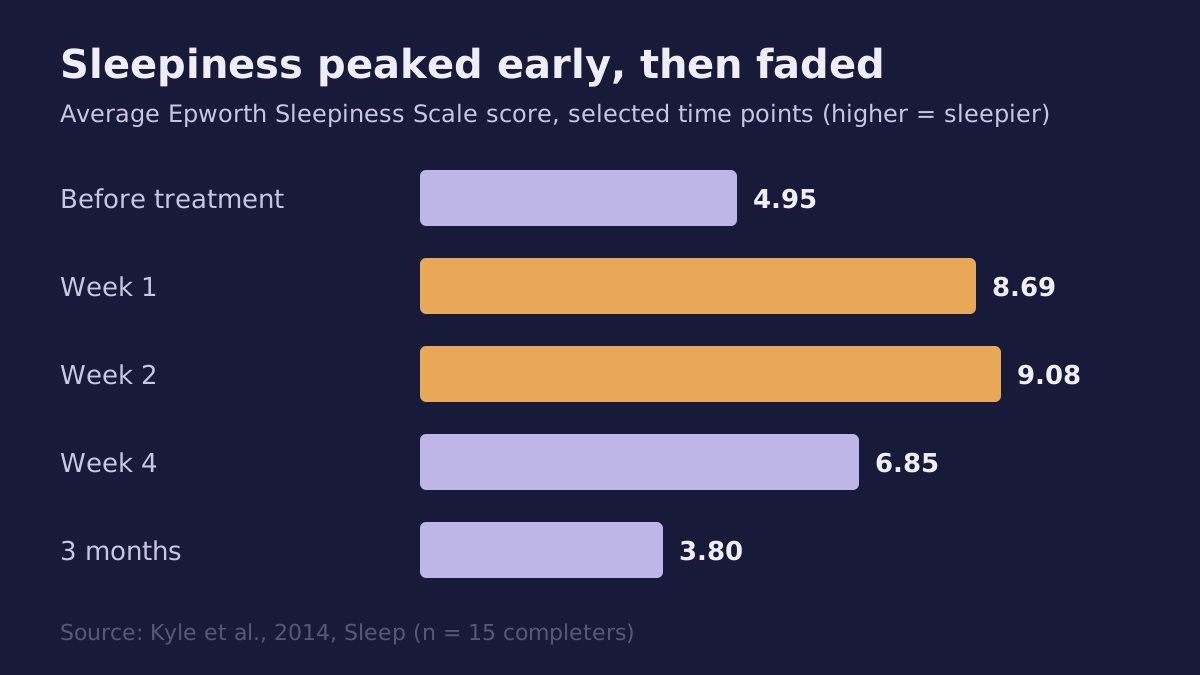
Research backs this up. In a small study of 18 adults starting sleep restriction, every single participant reported fatigue or exhaustion after starting, yet sleep diaries and insomnia scores had improved by the end of the 4-week program and stayed improved at 3 months (Kyle et al., 2011). In a sleep lab study, daytime sleepiness rose during weeks 1 to 3 and had returned to baseline by 3 months (Kyle et al., 2014). So the dip is real, it is expected, and for most people it is temporary.
Expected does not mean ignore it, though. Below is why the dip happens, a typical timeline, and signs your plan needs to change.
Why CBT-I can make sleep feel worse at first
CBT-I is a package. It usually combines sleep restriction, stimulus control, work on unhelpful thoughts about sleep, relaxation, and sleep hygiene. The first two are the parts most tied to the early slump.
Sleep restriction shrinks your time in bed on purpose
The American Academy of Sleep Medicine describes sleep restriction as limiting time in bed to roughly how long you actually sleep, based on your sleep diary, and then adjusting that window as your sleep becomes more efficient (Edinger et al., 2021). If you have been spending eight and a half hours in bed to get six hours of broken sleep, your new window might start near six hours.
The goal is not to deprive you. It is to stop the pattern where long, wakeful hours in bed teach your brain that bed is a place for lying awake. But in the short term, a smaller window often means less total sleep. In the lab study, people slept on average 91 fewer minutes on the first night of sleep restriction than at baseline, measured by overnight brain monitoring, and were still sleeping about 69 minutes less on night 22 (Kyle et al., 2014).
That lost sleep is part of how the method seems to work. A randomized trial that compared sleep restriction with simply keeping a regular schedule found that sleep restriction increased sleep pressure (more evening and daytime sleepiness, more slow-wave brain activity during sleep) and reduced mental arousal during the early weeks of treatment (Maurer et al., 2022). In plain terms: you are being made sleepier so that, when you do lie down, your brain is less able to stay wired.
Stimulus control adds more time out of bed
Stimulus control asks you to go to bed only when sleepy, get out of bed when you cannot sleep, keep a consistent wake-up time, and avoid reading or watching TV in bed (Edinger et al., 2021). On a bad night early in treatment, that can mean getting up several times, sitting in another room, and going back only when you feel sleepy. It can feel like the plan is costing you even more sleep, and in the first nights it sometimes is.
What the side effects usually look like
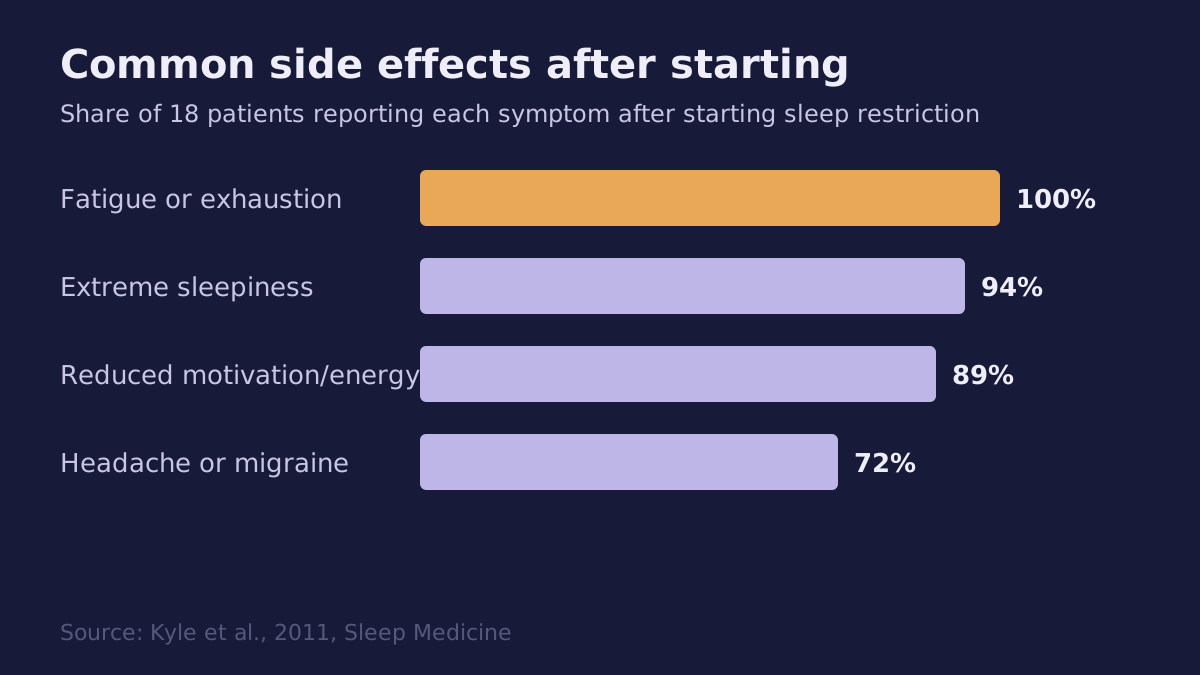
The most common complaints in the first weeks are the ones you would expect from short sleep. In the 2011 study, fatigue or exhaustion was reported by all participants, extreme sleepiness by 94%, reduced motivation or energy by 89%, and headache or migraine by 72% (Kyle et al., 2011). People reported an average of about seven symptoms each.
 Source: Kyle et al., 2011, Sleep Medicine
Attention can also slip. In the lab study, reaction times slowed and attention lapses increased at several points during treatment, then returned to baseline levels by 3 months (Kyle et al., 2014). The authors advised telling patients that vigilance may dip for a while, and participants were told not to drive or operate heavy machinery when they felt excessively sleepy. The AASM guideline likewise lists increased daytime sleepiness as a potential early harm of sleep restriction (Edinger et al., 2021).
How long the first-week dip usually lasts
There is no single timeline, but the studies give a reasonable picture.
- Week 1 to 2: This is usually the hardest stretch. In the randomized trial, daytime sleepiness was higher than in the comparison group at weeks 1 and 2, and alertness on a reaction-time test was lower at week 1 (Maurer et al., 2022).
- Week 3 to 4: In the lab study, sleepiness scores were still raised at week 3 but were no longer significantly different from baseline at week 4 (Kyle et al., 2014).
- By 3 months: Sleepiness and attention measures were back to baseline, while insomnia severity scores had fallen from 17.4 before treatment to about 5 (Kyle et al., 2014).
 Source: Kyle et al., 2014, Sleep
Part of the recovery comes from the plan itself. Your sleep window is not fixed. In the lab study, the window was reviewed weekly: if you were asleep for 90% or more of your time in bed, it grew by 15 minutes; between 85% and 89%, it stayed the same; below 85%, it shrank by 15 minutes, with a floor of 5 hours (Kyle et al., 2014). Programs differ, but most use some version of this step-by-step adjustment.
It also helps to know what CBT-I tends to change. A 2015 meta-analysis of 20 trials found that after treatment, people fell asleep about 19 minutes sooner, spent about 26 fewer minutes awake during the night, and spent about 10% more of their time in bed asleep, with gains that seemed to last (Trauer et al., 2015). Total sleep time changed little at the end of treatment. So if you judge the first week only by hours slept, it may look worse. How quickly you fall asleep and how much of the night you spend awake may be more useful markers.
How to get through the first two weeks
These are practical ways people manage the dip. They are not a substitute for the instructions your own clinician or program gives you.
- Keep the wake-up time fixed. A consistent rise time is one of the core stimulus control instructions (Edinger et al., 2021), so try to hold it even after a bad night.
- Plan for sleepiness. Avoid driving or risky tasks when you feel very sleepy. The large primary care trial of sleep restriction built advice on managing daytime sleepiness, including implications for driving, into the very first session (Kyle et al., 2023).
- Have a quiet plan for the evening. The AASM notes that some people find it hard to fill the extra waking time that sleep restriction creates (Edinger et al., 2021). Deciding in advance what you will do, and where, can make the late evening easier to get through.
- Keep filling in the diary. Your window can only be adjusted if there is data to adjust it with.
- Look at the trend, not one night. A single bad night in week one says little about where you will be in week four.
When to adjust the plan or bring in a clinician
The AASM notes that sleep restriction may not be appropriate for everyone, including people in high-risk jobs, people prone to mania or hypomania, and people with poorly controlled seizures, and it describes treatment with a clinician monitoring the patient (Edinger et al., 2021). Talk with a clinician before continuing, or ask for a wider sleep window, if any of these apply:
- You are nodding off while driving, at work around machinery, or in other situations where sleepiness could cause harm.
- You have bipolar disorder, a seizure disorder, or another condition your doctor has not yet weighed in on.
- You snore loudly, stop breathing or gasp during sleep, or wake unrefreshed no matter how long you sleep. These can point to sleep apnea, which needs its own in-person evaluation.
- Your mood is dropping noticeably, or you have a health condition that makes sitting up at night hard.
- You are past week four, your diary shows little change, and the window is not growing.
The lab study authors suggested a more generous starting window for people who are already very sleepy before treatment (Kyle et al., 2014). A clinician can help you decide whether that applies to you.
If low mood ever turns into thoughts of harming yourself, call or text 988 to reach the 988 Suicide and Crisis Lifeline any time.
Does pushing through actually pay off?
For many people, research suggests it does. In a trial of 642 adults in 35 general practices in England, four brief nurse-led sessions of sleep restriction led to lower insomnia severity at 6 months than a sleep hygiene booklet alone, and serious adverse events were equal between groups (eight in each), with none judged to be related to the treatment (Kyle et al., 2023). The AASM gives multicomponent CBT-I its only strong recommendation for chronic insomnia in adults (Edinger et al., 2021).
Results vary between people, and not every plan suits every person. A tough first week is common, but it is a reason to stay in touch with whoever is guiding your treatment, not a sign you should quit or push through on your own.
Frequently asked questions
Is it normal to sleep less during the first week of CBT-I?
Yes. When sleep restriction is part of the program, total sleep often drops at first because your time in bed is shorter. In one lab study, people slept about 91 fewer minutes on the first night than at baseline (Kyle et al., 2014). The window is then widened as your sleep becomes more consolidated.
How long does the sleep restriction tiredness last?
In the studies above, sleepiness was highest in weeks 1 and 2, was no longer significantly above baseline by week 4, and was back to normal levels by 3 months. Your own timeline depends on your starting point and how your window is adjusted. If you are not seeing any improvement after about a month, review the plan with your clinician.
Should I stop CBT-I if I feel worse?
Feeling more tired early on is an expected part of the process, so it is not by itself a reason to stop. But dangerous sleepiness, such as drowsiness while driving, is a reason to talk with a clinician promptly and possibly widen your sleep window. Avoid changing the plan on your own without that conversation.
Can I nap during CBT-I?
Ask whoever is guiding your treatment. Sleep restriction appears to work partly by building sleep pressure (Maurer et al., 2022), so naps are worth planning with your clinician rather than deciding night by night. If sleepiness is making it hard to stay alert during risky tasks, raise that right away.
Sources
- Edinger JD, Arnedt JT, Bertisch SM, et al. 2021. Behavioral and psychological treatments for chronic insomnia disorder in adults: an American Academy of Sleep Medicine clinical practice guideline. Journal of Clinical Sleep Medicine. https://doi.org/10.5664/jcsm.8986
- Kyle SD, Morgan K, Spiegelhalder K, Espie CA. 2011. No pain, no gain: an exploratory within-subjects mixed-methods evaluation of the patient experience of sleep restriction therapy (SRT) for insomnia. Sleep Medicine. https://doi.org/10.1016/j.sleep.2011.03.016
- Kyle SD, Miller CB, Rogers Z, Siriwardena AN, MacMahon KM, Espie CA. 2014. Sleep restriction therapy for insomnia is associated with reduced objective total sleep time, increased daytime somnolence, and objectively impaired vigilance. Sleep. https://doi.org/10.5665/sleep.3386
- Kyle SD, Siriwardena AN, Espie CA, et al. 2023. Clinical and cost-effectiveness of nurse-delivered sleep restriction therapy for insomnia in primary care (HABIT). The Lancet. https://doi.org/10.1016/S0140-6736(23)00683-9
- Maurer LF, Espie CA, Omlin X, Emsley R, Kyle SD. 2022. The effect of sleep restriction therapy for insomnia on sleep pressure and arousal: a randomized controlled mechanistic trial. Sleep. https://pubmed.ncbi.nlm.nih.gov/34463762/
- Trauer JM, Qian MY, Doyle JS, Rajaratnam SM, Cunnington D. 2015. Cognitive behavioral therapy for chronic insomnia: a systematic review and meta-analysis. Annals of Internal Medicine. https://pubmed.ncbi.nlm.nih.gov/26054060/
This article is for general education and is not medical advice. Talk with a licensed clinician about your own symptoms before starting, stopping, or changing any treatment.