October 26, 2026
How Long Should Insomnia Last Before Seeing a Doctor?
By the My Circadian Health editorial team. Reviewed by Brandon Korenek, Founder.

How long should insomnia last before seeing a doctor?
If you are wondering how long insomnia should last before seeing a doctor, the clinical benchmark is about three months. The National Heart, Lung, and Blood Institute describes chronic insomnia as trouble sleeping that happens three or more nights a week and lasts more than three months (NHLBI). If that describes you, it is a good time to book a visit.
But you do not have to wait for the three-month mark. The same agency's advice is simpler: if not getting enough sleep is affecting your daily activities, talk to your doctor (NHLBI). And a few warning signs, covered below, are reasons to go much sooner. On the other hand, a handful of bad nights after a deadline, a move, or a loss is common and often settles on its own.
Short-term vs. chronic insomnia
Doctors split insomnia into two broad types based on how long it lasts.
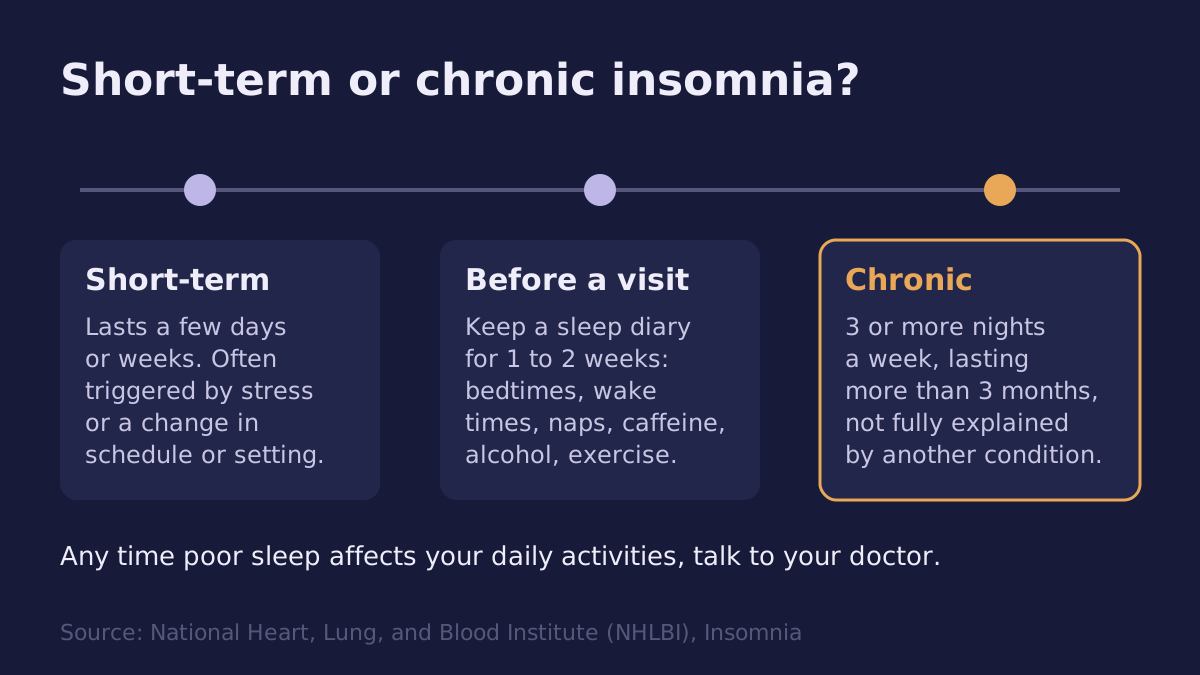
Short-term insomnia can last a few days or weeks. It is often triggered by stress or by changes in your schedule or environment, such as travel, a new job, or a new baby in the house (NHLBI).
Chronic insomnia is trouble falling or staying asleep three or more nights a week for more than three months, when it is not fully explained by another health problem (NHLBI).
 Source: National Heart, Lung, and Blood Institute, Insomnia health topic
The three-month line is a diagnostic threshold, not a waiting period you have to endure. Its purpose is to separate a passing reaction to life events from a pattern that has taken on a life of its own.
Most short bouts pass, but not all
Research on how insomnia unfolds over time is reassuring in one way and sobering in another.
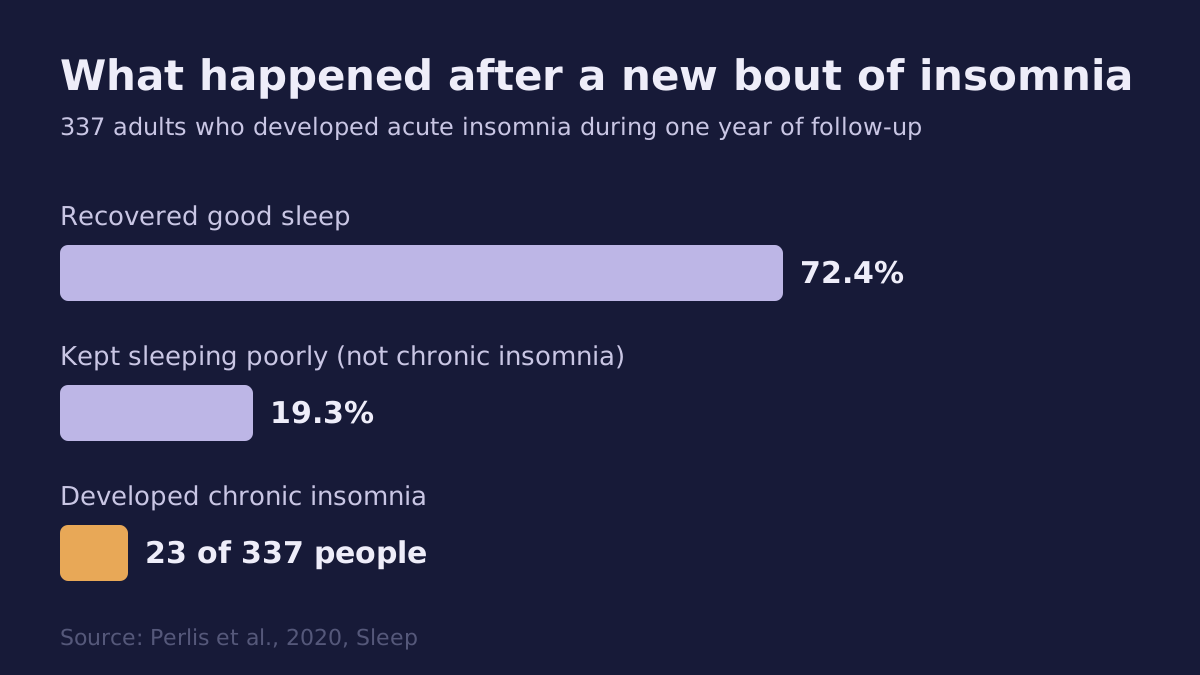
In a 2020 study in Sleep, researchers followed 1,248 adults who started out as good sleepers for one year (Perlis et al.). During that year, 27% developed a bout of acute insomnia. Of those, 72.4% went on to recover good sleep. Another 19.3% kept sleeping poorly without meeting the criteria for chronic insomnia, and 23 people went on to develop chronic insomnia.
 Source: Perlis et al., 2020, Sleep
Once insomnia is established, though, it tends to stick. A three-year study of 388 adults with insomnia in Archives of Internal Medicine found that 74% still reported insomnia a year later and 46% reported it throughout all three years (Morin et al.). About 54% had a remission at some point, but 27% of those relapsed.
The practical takeaway: if your sleep trouble started recently and you can point to a clear trigger, giving it a few weeks is reasonable. If it has outlasted the trigger, or keeps coming back, waiting longer is less likely to fix it.
Signs you should see a doctor sooner
Some situations call for a conversation well before three months.
Your days are suffering
Trouble concentrating at work, irritability that is straining relationships, or dragging through the day are the clearest signals. NHLBI's guidance is to talk to a doctor whenever lost sleep is affecting your daily activities, regardless of how long it has gone on (NHLBI).
You nod off while driving or doing something risky
Falling asleep at the wheel or while operating equipment is a reason to stop that activity and get checked promptly, not to wait and see.
Loud snoring, gasping, or pauses in breathing
Frequent loud snoring, gasping for air, and breathing that starts and stops are symptoms of sleep apnea, and insomnia itself can be one of its symptoms (NHLBI). If a bed partner has noticed any of these, see a clinician in person, because diagnosis may need a sleep study.
Low mood, anxiety, or hopelessness
Insomnia and depression are closely linked. A meta-analysis of 21 longitudinal studies found that people without depression who had insomnia had about twice the risk of later developing depression compared with people without sleep problems (Baglioni et al.). If your sleep trouble comes with persistent low mood or anxiety, raise both with a clinician you can see in person.
If you are having thoughts of harming yourself, call or text 988 to reach the 988 Suicide and Crisis Lifeline, available 24 hours a day. If you are in immediate danger, call 911.
Something else changed
New medicines, pregnancy, menopause, other health conditions, or changes in caffeine, alcohol, or other substance use can all affect sleep, which is why doctors ask about them (NHLBI). If your insomnia started alongside one of these, the clinician who manages that condition or your pregnancy is the right first call.
What happens when you see a doctor for insomnia
A lot of people put off the visit because they are not sure what it involves. It is mostly a conversation.
Before the visit: keep a sleep diary
NHLBI suggests keeping a sleep diary for one to two weeks beforehand (NHLBI). Each day, write down:
- When you went to bed, fell asleep, and woke up
- Any naps
- How sleepy you felt during the day
- When you had caffeine or alcohol
- When you exercised
A diary turns "I never sleep" into a pattern a clinician can work with, and it often surfaces things you had not noticed, like a late afternoon coffee habit or a weekend schedule that runs three hours later.
During the visit: questions
Expect questions about how often you have trouble sleeping, how long it has been going on, your schedule on workdays and days off, screen use before bed, whether you snore or wake up gasping, your health conditions and medicines, and your use of caffeine, nicotine, alcohol, or other substances (NHLBI).
Tests, if needed
Many people do not need any tests. When a doctor wants more information, options include (NHLBI):
- A sleep study to look for other sleep problems such as sleep apnea, circadian rhythm disorders, or narcolepsy
- Actigraphy, a wrist-worn motion sensor used for 3 to 14 days to track rest and activity
- Blood tests to check for thyroid problems or other conditions that can affect sleep
What treatment usually starts with
For chronic insomnia, the main U.S. guidelines point first to a structured, non-drug approach.
The American College of Physicians recommends cognitive behavioral therapy for insomnia (CBT-I) as the initial treatment for all adults with chronic insomnia disorder (Qaseem et al.). The American Academy of Sleep Medicine also recommends multicomponent CBT-I, and suggests that sleep hygiene advice on its own not be used as a stand-alone treatment (Edinger et al.).
CBT-I combines techniques such as stimulus control (using the bed only for sleep), sleep restriction (temporarily matching time in bed to actual sleep), relaxation training, and working on unhelpful thoughts about sleep. A 2015 meta-analysis of 20 trials in Annals of Internal Medicine found that, on average, CBT-I was associated with falling asleep about 19 minutes sooner and spending about 26 fewer minutes awake after first falling asleep, with improvements that seemed to last at later follow-ups (Trauer et al.). Results vary from person to person.
Medication is one option a clinician may discuss. The ACP guideline advises that, when CBT-I alone has not worked, clinicians and patients use shared decision-making, weighing the benefits, harms, and costs of short-term medication (Qaseem et al.). Whether any medication is appropriate for you is a decision for a licensed clinician after an evaluation, and many visits end with a behavioral plan rather than a prescription.
Putting it together
- A few nights to a few weeks, with a clear trigger: common, and often settles. Protect a regular wake time and give it some time.
- Lost sleep is affecting your days: talk to a doctor now, whatever the duration.
- Snoring, gasping, mood changes, or drowsy driving: see a clinician in person sooner rather than later.
- Three or more nights a week for about three months: this meets the definition of chronic insomnia, and it is worth an evaluation.
Frequently asked questions
Is it normal to have insomnia for a week?
Yes, a week or two of poor sleep after stress, travel, or a schedule change is common. NHLBI describes short-term insomnia as lasting a few days or weeks. If it is affecting your daily life, though, it is reasonable to talk to a doctor even at this stage.
Can insomnia go away on its own?
Often, yes. In one study, 72.4% of people who developed a new bout of insomnia recovered good sleep within the year. Once insomnia becomes chronic, it is more likely to persist, which is why an evaluation makes sense at that point.
What kind of doctor should I see for insomnia?
A primary care doctor is a good place to start. They can look for contributing health conditions or medicines and refer you to a sleep specialist or a CBT-I provider if needed. If you have signs of sleep apnea, a sleep study may be part of the workup.
Should I see a doctor after one night of no sleep?
One sleepless night on its own is usually not a reason for a visit. Seek care promptly if it comes with chest pain, confusion, thoughts of self-harm, or other new and severe symptoms, or if sleepless nights keep piling up and affecting your days.
Can a doctor treat insomnia without medication?
Yes. U.S. guidelines from the American College of Physicians and the American Academy of Sleep Medicine recommend cognitive behavioral therapy for insomnia as the first treatment for chronic insomnia. Your clinician can talk with you about whether any other treatment makes sense for you.
Sources
- Baglioni C, Battagliese G, Feige B, et al. (2011). Insomnia as a predictor of depression: a meta-analytic evaluation of longitudinal epidemiological studies. Journal of Affective Disorders. https://doi.org/10.1016/j.jad.2011.01.011
- Edinger JD, Arnedt JT, Bertisch SM, et al. (2021). Behavioral and psychological treatments for chronic insomnia disorder in adults: an American Academy of Sleep Medicine clinical practice guideline. Journal of Clinical Sleep Medicine. https://doi.org/10.5664/jcsm.8986
- Morin CM, Bélanger L, LeBlanc M, et al. (2009). The natural history of insomnia: a population-based 3-year longitudinal study. Archives of Internal Medicine. https://doi.org/10.1001/archinternmed.2008.610
- National Heart, Lung, and Blood Institute. Insomnia. https://www.nhlbi.nih.gov/health/insomnia
- National Heart, Lung, and Blood Institute. Insomnia: Diagnosis. https://www.nhlbi.nih.gov/health/insomnia/diagnosis
- National Heart, Lung, and Blood Institute. Sleep Apnea: Symptoms. https://www.nhlbi.nih.gov/health/sleep-apnea/symptoms
- Perlis ML, Vargas I, Ellis JG, et al. (2020). The natural history of insomnia: the incidence of acute insomnia and subsequent progression to chronic insomnia or recovery in good sleeper subjects. Sleep. https://doi.org/10.1093/sleep/zsz299
- Qaseem A, Kansagara D, Forciea MA, et al. (2016). Management of chronic insomnia disorder in adults: a clinical practice guideline from the American College of Physicians. Annals of Internal Medicine. https://doi.org/10.7326/M15-2175
- Trauer JM, Qian MY, Doyle JS, et al. (2015). Cognitive behavioral therapy for chronic insomnia: a systematic review and meta-analysis. Annals of Internal Medicine. https://doi.org/10.7326/M14-2841
This article is for general education and is not medical advice. Talk with a licensed clinician about your own symptoms before starting, stopping, or changing any treatment.