October 30, 2026
Melatonin Stopped Working? Why, and What to Do Next
By the My Circadian Health editorial team. Reviewed by Brandon Korenek, Founder.

Why melatonin stopped working: the short answer
If melatonin stopped working for you, or never worked well, the most likely explanation is not that your body "got used to it." It is that melatonin was never doing the job you hired it for. Melatonin is a hormone your brain releases in the evening to tell the rest of your body that night is coming. As a supplement, it nudges the timing of that signal. It is not a sedative, and in people with ordinary insomnia its measurable effect on falling asleep is a matter of minutes.
So when melatonin seems to fade, one of a few things is usually going on: its small effect was masked by expectation at first, the product does not contain what the label says, the dose or timing is working against your rhythm, or the real cause of poor sleep is one melatonin cannot touch. This article covers each, with the research behind it, and ends with what to do when melatonin stops working.
Melatonin is a timing signal, not a sedative
Your pineal gland starts releasing melatonin in dim light a couple of hours before your usual bedtime, and the clock time of that onset varies widely. In a study of healthy adults, the onset of melatonin secretion ranged from 6:13 p.m. to 12:26 a.m. (Burgess and Fogg, 2008). That six-hour spread is one reason a fixed "take it at 10 p.m." habit gives such different results for different people.
Supplemental melatonin acts on the same receptors as your own, which makes it useful when the problem is when your body wants to sleep. It does much less for hyperarousal, a racing mind, pain, interrupted breathing, or a bedroom habit loop, because none of those are timing problems. That distinction explains most of the "why doesn't melatonin work for me" stories on forums.
What the research actually shows
Three widely cited meta-analyses pooled the randomized trials, and they agree on the size of the effect.
- Sleep Medicine Reviews, 17 studies: melatonin shortened sleep onset by 4.0 minutes, added 12.8 minutes of total sleep, and raised sleep efficiency by 2.2 points (Brzezinski et al., 2005).
- Journal of General Internal Medicine: sleep onset improved by 7.2 minutes in primary insomnia, and the authors found no evidence of effectiveness for most primary sleep disorders with short-term use. The exception was delayed sleep phase syndrome, where onset improved by 38.8 minutes (Buscemi et al., 2005).
- PLoS ONE, 19 trials and 1,683 participants: sleep onset improved by about 7 minutes and total sleep time by about 8 minutes, with a small gain in subjective sleep quality (Ferracioli-Oda et al., 2013).
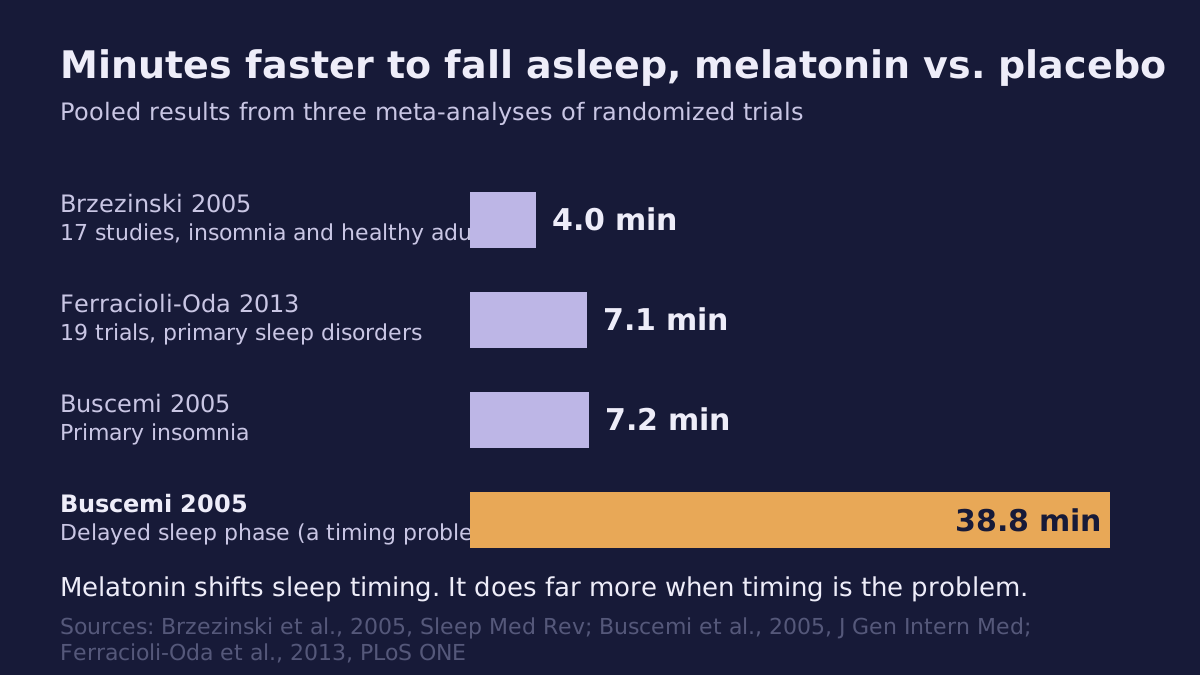 Source: Brzezinski et al., 2005, Sleep Medicine Reviews; Buscemi et al., 2005, Journal of General Internal Medicine; Ferracioli-Oda et al., 2013, PLoS ONE
Those numbers are real, but small. If you felt a dramatic difference at first that later vanished, the early difference was probably expectation layered on a modest effect. Expectation fades; the seven minutes were there all along.
This is why the American Academy of Sleep Medicine's 2017 guideline suggests that clinicians not use melatonin for sleep onset or sleep maintenance insomnia in adults, rating the evidence very low quality and the benefits roughly equal to harms. The same guideline says all patients with chronic insomnia should receive cognitive behavioral therapy for insomnia (CBT-I) as a primary intervention, with medication considered mainly for those who cannot do CBT-I or still have symptoms afterward (Sateia et al., 2017).
Dose and timing: why more is not better
A common response to melatonin not working anymore is to take more. The research does not support that instinct.
In a double-blind study at MIT, older adults with insomnia took 0.1 mg, 0.3 mg, or 3.0 mg of melatonin 30 minutes before bed. The 0.3 mg dose, which raised blood melatonin into the normal nighttime range, produced the clearest improvement in sleep efficiency. The 3.0 mg dose, the low end of most retail bottles, kept plasma melatonin elevated into daylight hours and lowered body temperature (Zhdanova et al., 2001).
Timing matters at least as much. In the Cochrane review of melatonin for jet lag, doses from 0.5 mg to 5 mg were similarly effective, doses above 5 mg were not more effective, and the authors stressed taking it close to the target bedtime, because taking it at the wrong time of day can cause sleepiness and delay adaptation (Herxheimer and Petrie, 2002).
None of this is a dosing recommendation. It is what the trials found; the appropriate amount and timing for you, if any, is a conversation for a licensed clinician.
Where melatonin does have guideline support
Melatonin is specific, not useless. The AASM's 2015 guideline on circadian rhythm sleep-wake disorders suggests strategically timed melatonin for delayed sleep-wake phase disorder in adults and in children and adolescents, and for non-24-hour sleep-wake rhythm disorder in blind adults. It found no evidence supporting melatonin for advanced sleep-wake phase disorder and suggests against it for irregular sleep-wake rhythm in older adults with dementia (Auger et al., 2015).
Every supported use is a problem of timing. A night owl who cannot fall asleep before 2 a.m. but sleeps fine afterward is who melatonin was built for. Someone who falls asleep easily and wakes at 3 a.m. is not.
Is "melatonin tolerance" a real thing?
People search for "melatonin tolerance" because the word fits the experience. But the long-term data do not show the classic pattern, where the same dose produces a shrinking effect.
In a six-month randomized placebo-controlled trial of 791 adults with primary insomnia, improvements with a 2 mg prolonged-release preparation were "maintained or enhanced over the 6-month period with no signs of tolerance" (Wade et al., 2010). An open-label extension of 6 to 12 months likewise found no evidence of tolerance, and stopping was not associated with rebound insomnia or withdrawal symptoms (Lemoine et al., 2011). Both studies involved the product's manufacturer and used a prolonged-release formulation unlike most U.S. supplements, so they are not the last word. But they are the best long-term evidence available, and they point away from tolerance.
The bottle may not contain what the label says
In the United States melatonin is a dietary supplement, and its content is not verified before sale. When researchers analyzed 31 melatonin supplements from grocery stores and pharmacies, actual content ranged from 83 percent below to 478 percent above the label. More than 71 percent missed their label claim by more than 10 percent. Content varied between lots of the same product by as much as 465 percent, and 26 percent of the supplements contained serotonin, which was not on the label (Erland and Saxena, 2017).
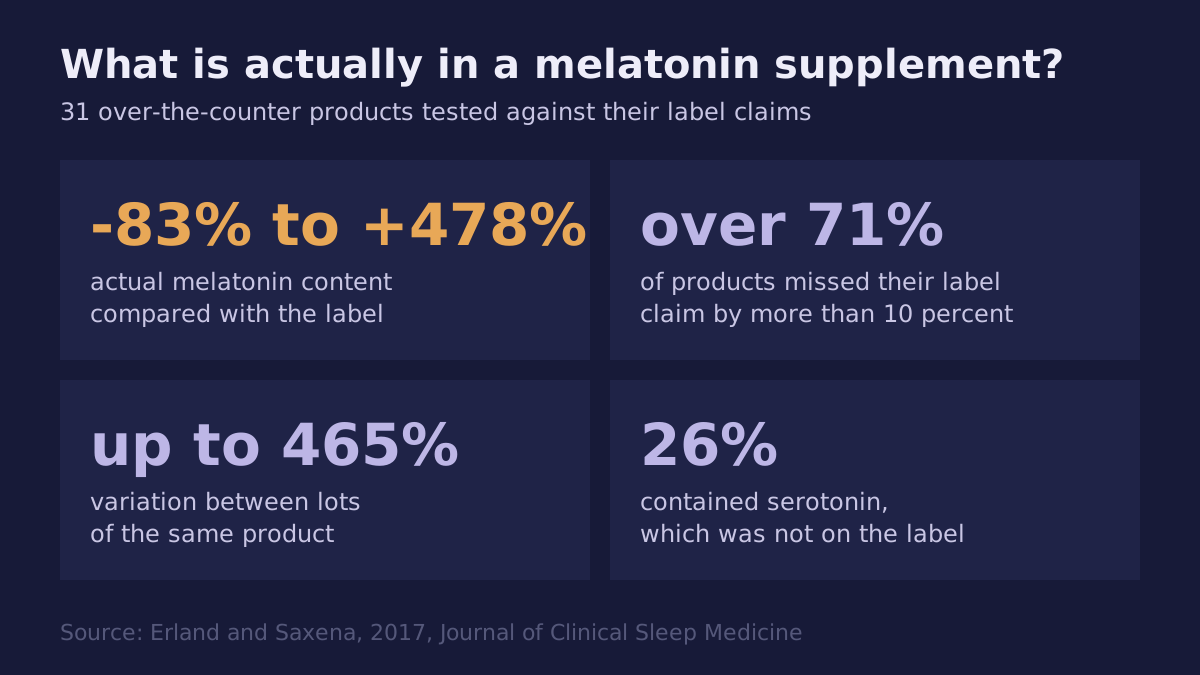 Source: Erland and Saxena, 2017, Journal of Clinical Sleep Medicine
If you switched brands, or your brand switched lots, "melatonin stopped working" may mean you are taking a different amount than before.
The real question: what is actually keeping you awake?
Chronic insomnia disorder. Trouble falling or staying asleep at least three nights a week for three months or more, with daytime consequences, is a condition in its own right, and its first-line treatment is CBT-I. If sleep hygiene advice has not been enough, our article on why sleep hygiene alone often fails explains what CBT-I does differently.
Circadian misalignment. Caffeine is a clock-shifter, not just a stimulant. The caffeine equivalent of a double espresso taken three hours before habitual bedtime delayed the circadian melatonin rhythm by about 40 minutes (Burke et al., 2015).
Waking in the middle of the night. Melatonin's measurable effect is on falling asleep. If your problem is waking at 2 or 3 a.m., the causes and fixes differ. We cover them in why you are not sleeping through the night.
Something a clinician needs to rule out. Loud snoring, pauses in breathing noticed by a partner, waking unrefreshed despite enough hours, persistent low mood or anxiety, restless legs, or heavy evening alcohol use are all things a sleep evaluation asks about. Each can drive insomnia on its own and deserves direct, in-person attention.
What to do when melatonin stops working
- Stop raising the dose. The trials that found a benefit used small amounts, and higher doses left melatonin circulating in the daytime.
- Keep a two-week sleep diary. Bedtime, lights-out, time to fall asleep, every waking, final wake time, and caffeine and alcohol timing. This is what a clinician will ask for, and it shows whether your problem is onset, maintenance, or timing.
- Sort yourself honestly. Can't fall asleep until very late but sleep fine after? That points toward a circadian issue, the one category where melatonin has guideline support. Fall asleep but wake repeatedly? Melatonin was never shown to help that. Both? Chronic insomnia is likely, and CBT-I is the first-line path.
- Talk to a physician. A sleep evaluation reviews your diary, screens for apnea, mood disorders, restless legs, and medication or substance effects, and considers your circadian pattern. Options may include CBT-I, a structured light and timing plan, or in some cases a prescription. Whether medication is appropriate is a decision a licensed clinician makes after that evaluation, not a default outcome.
Frequently asked questions
Can you build a tolerance to melatonin?
The long-term studies that looked for it, a six-month randomized trial and a 12-month open-label extension of a prolonged-release product, found no loss of effect over time and no rebound insomnia on stopping. Those studies had manufacturer involvement, so tolerance cannot be ruled out entirely, but the available evidence points to other explanations.
Why does melatonin work for some people and not others?
Melatonin shifts the timing of sleep rather than forcing it. People whose body clock runs late see a large benefit, about 39 minutes faster sleep onset in meta-analysis, while people with ordinary insomnia see about 4 to 7 minutes. Supplement content also varies widely between brands and lots, so two people taking "3 mg" may be taking very different amounts.
Should I take a higher dose if melatonin stopped working?
The research does not support it. A 0.3 mg dose raised melatonin to normal nighttime levels in one controlled study, while 3 mg left it elevated into the next day, and in jet lag trials doses above 5 mg were not more effective. Timing, and whether your problem is one melatonin can address, matter more than the number on the bottle.
What should I try instead of melatonin for insomnia?
For chronic insomnia, the AASM names cognitive behavioral therapy for insomnia as the primary treatment. It targets the arousal and conditioning that keep insomnia going, which melatonin does not address. If CBT-I is not available or has not been enough, a physician can evaluate whether another approach is appropriate.
Sources
- Auger RR, Burgess HJ, Emens JS, et al. (2015). Clinical practice guideline for the treatment of intrinsic circadian rhythm sleep-wake disorders. Journal of Clinical Sleep Medicine, 11(10), 1199–1236. https://doi.org/10.5664/jcsm.5100
- Brzezinski A, Vangel MG, Wurtman RJ, et al. (2005). Effects of exogenous melatonin on sleep: a meta-analysis. Sleep Medicine Reviews, 9(1), 41–50. https://doi.org/10.1016/j.smrv.2004.06.004
- Burgess HJ, Fogg LF. (2008). Individual differences in the amount and timing of salivary melatonin secretion. PLoS ONE, 3(8), e3055. https://doi.org/10.1371/journal.pone.0003055
- Burke TM, Markwald RR, McHill AW, et al. (2015). Effects of caffeine on the human circadian clock in vivo and in vitro. Science Translational Medicine, 7(305), 305ra146. https://doi.org/10.1126/scitranslmed.aac5125
- Buscemi N, Vandermeer B, Hooton N, et al. (2005). The efficacy and safety of exogenous melatonin for primary sleep disorders: a meta-analysis. Journal of General Internal Medicine, 20(12), 1151–1158. https://doi.org/10.1111/j.1525-1497.2005.0243.x
- Erland LA, Saxena PK. (2017). Melatonin natural health products and supplements: presence of serotonin and significant variability of melatonin content. Journal of Clinical Sleep Medicine, 13(2), 275–281. https://doi.org/10.5664/jcsm.6462
- Ferracioli-Oda E, Qawasmi A, Bloch MH. (2013). Meta-analysis: melatonin for the treatment of primary sleep disorders. PLoS ONE, 8(5), e63773. https://doi.org/10.1371/journal.pone.0063773
- Herxheimer A, Petrie KJ. (2002). Melatonin for the prevention and treatment of jet lag. Cochrane Database of Systematic Reviews, (2), CD001520. https://doi.org/10.1002/14651858.CD001520
- Lemoine P, Garfinkel D, Laudon M, Nir T, Zisapel N. (2011). Prolonged-release melatonin for insomnia: an open-label long-term study of efficacy, safety, and withdrawal. Therapeutics and Clinical Risk Management, 7, 301–311. https://doi.org/10.2147/TCRM.S23036
- Sateia MJ, Buysse DJ, Krystal AD, Neubauer DN, Heald JL. (2017). Clinical practice guideline for the pharmacologic treatment of chronic insomnia in adults. Journal of Clinical Sleep Medicine, 13(2), 307–349. https://doi.org/10.5664/jcsm.6470
- Wade AG, Ford I, Crawford G, et al. (2010). Nightly treatment of primary insomnia with prolonged release melatonin for 6 months: a randomized placebo controlled trial. BMC Medicine, 8, 51. https://doi.org/10.1186/1741-7015-8-51
- Zhdanova IV, Wurtman RJ, Regan MM, et al. (2001). Melatonin treatment for age-related insomnia. Journal of Clinical Endocrinology and Metabolism, 86(10), 4727–4730. https://doi.org/10.1210/jcem.86.10.7901
This article is for general education and is not medical advice. Talk with a licensed clinician about your own symptoms before starting, stopping, or changing any treatment.