October 27, 2026
Sleep Hygiene Not Working? What It Can't Fix and What Can
By the My Circadian Health editorial team. Reviewed by Brandon Korenek, Founder.
The short answer: sleep hygiene not working is a signal, not a failure
If you have kept a steady schedule, cooled and darkened the room, put the phone away, and cut afternoon caffeine for weeks and you still lie awake, you have not failed at sleep hygiene. You have run a useful test. Hygiene removes the everyday habits that make sleep worse. When those are gone and sleep is still broken, something else is holding the problem in place, and that something is usually treatable once it is named.
The most common culprit is chronic insomnia disorder itself, which research now treats as a conditioned, over-aroused state rather than a habit problem. Behind it sit a handful of medical and circadian causes that no bedtime routine can touch: untreated sleep apnea, a body clock that runs late, restless legs linked to low iron, thyroid disease, chronic pain, anxiety or depression, and medications or substances that fragment sleep. This article walks through each one, how to tell which fits you, and what a physician evaluation actually involves.
Why good sleep hygiene is not enough on its own
A 2015 review in Sleep Medicine Reviews (Irish et al.) found that individual sleep hygiene components, such as caffeine timing and regular schedules, are each linked to sleep in the general population, but that sleep hygiene education as a treatment for clinical insomnia has been largely ineffective. A 2018 meta-analysis in Family Practice (Chung et al.) put numbers on it: sleep hygiene education improved sleep-diary sleep efficiency by about 5 percentage points on average, while cognitive behavioral therapy for insomnia (CBT-I) beat it by a further 8 points, a medium-to-large difference.
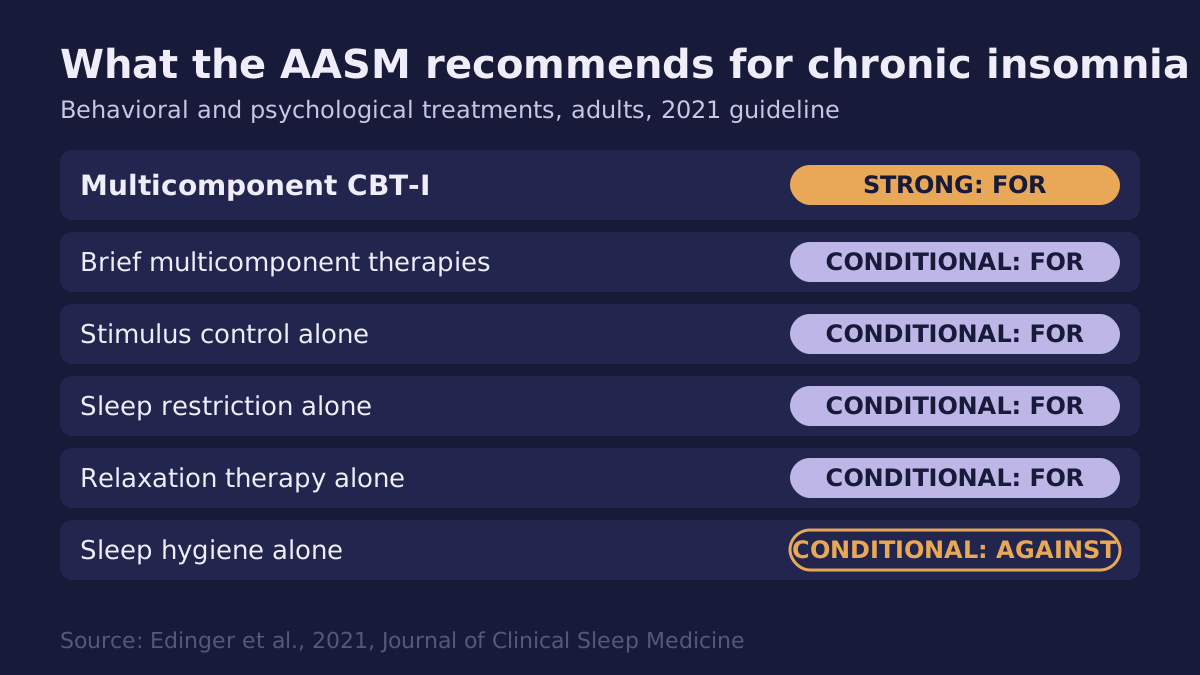
That is why the American Academy of Sleep Medicine's 2021 clinical practice guideline (Edinger et al.) gives a strong recommendation for multicomponent CBT-I and a conditional recommendation against using sleep hygiene as a stand-alone therapy, noting that its benefits alone were minimal and not clearly better than control conditions. The guideline still includes sleep hygiene inside multicomponent treatment. In other words, good sleep hygiene is the floor, not the fix.
Six reasons sleep hygiene isn't enough, and how to spot each one
1. Chronic insomnia has become a conditioned, hyperaroused state
The behavioral model of insomnia described by Spielman and colleagues in 1987 (Spielman et al.) explains the pattern most people with "good sleep hygiene but still can't sleep" recognize. A stressful event triggers a bad stretch of sleep. The stress passes, but the perpetuating factors it created do not: going to bed early to "catch up," lying awake for long stretches, dreading the night, watching the clock. The bed becomes a cue for wakefulness through simple conditioning.
A 2010 review in Sleep Medicine Reviews (Riemann et al.) adds the physiological piece: people with chronic insomnia show elevated arousal across autonomic, hormonal, and brain-activity measures, both at night and during the day. Worry, rumination, and learned sleep-preventing associations keep that arousal high. A dark, cool, screen-free room does nothing to a nervous system that has learned to switch on at bedtime.
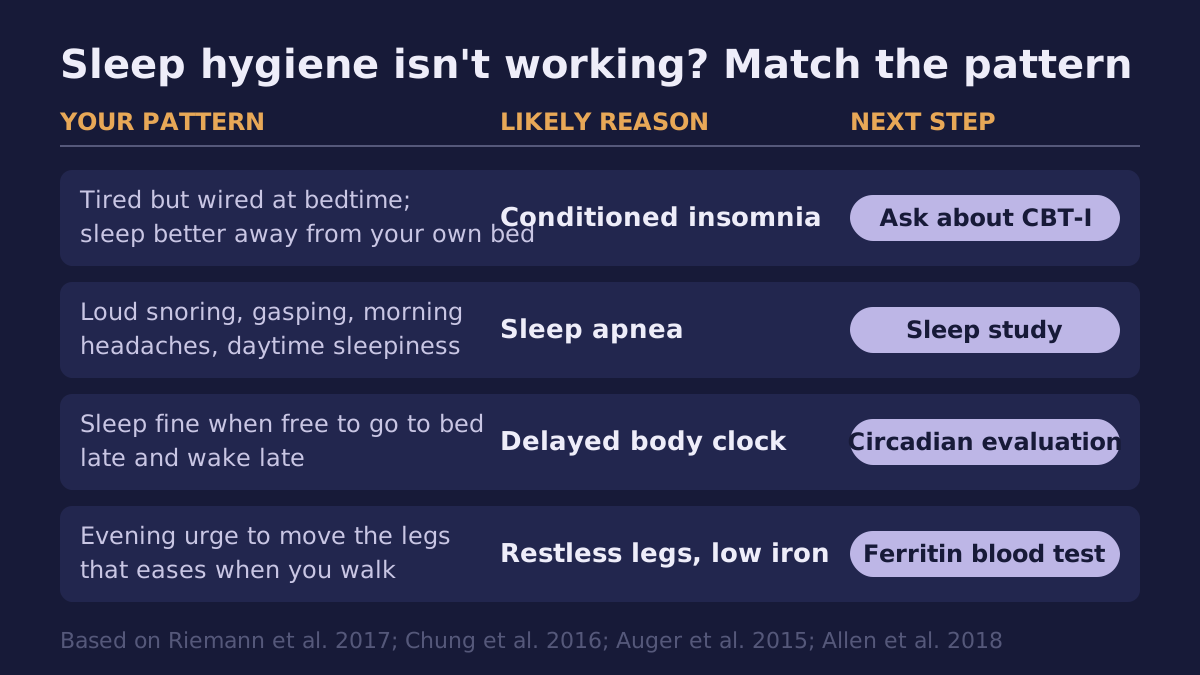
Signs this fits you: You feel tired but "wired" at bedtime, you sleep better away from your own bed, your mind races as soon as the lights go off, and you can fall asleep on the couch but not in bed.
What works: CBT-I, which retrains the conditioning with sleep restriction, stimulus control, and cognitive techniques. A 2015 meta-analysis in Annals of Internal Medicine (Trauer et al.) found CBT-I shortened time to fall asleep by about 19 minutes, cut time awake during the night by about 26 minutes, and raised sleep efficiency by nearly 10 percentage points. The American College of Physicians (Qaseem et al.) recommends CBT-I as the initial treatment for all adults with chronic insomnia disorder, and reserves the question of adding medication for a shared decision between patient and clinician only if CBT-I alone has not been enough.
2. Untreated sleep apnea is fragmenting your night
A 2019 analysis in The Lancet Respiratory Medicine (Benjafield et al.) estimated that roughly 936 million adults aged 30 to 69 worldwide have obstructive sleep apnea, and about 425 million have moderate to severe disease. Many of those people experience it as insomnia: frequent waking, unrefreshing sleep, and daytime fatigue.
Signs this fits you: Loud snoring, pauses in breathing or gasping that a partner notices, morning headaches, dry mouth on waking, high blood pressure, or falling asleep unintentionally during the day. The STOP-Bang questionnaire (Chung et al.) asks eight yes/no questions about snoring, tiredness, observed apneas, blood pressure, BMI, age, neck size, and sex; a score of 3 or more detects moderate to severe apnea with 93% sensitivity.
What works: A sleep study and in-person treatment. If this pattern fits, that appointment comes before anything else.
3. Your body clock runs late (delayed sleep-wake phase)
Some people are not insomniacs at all. They sleep well, just hours later than the world expects. Forcing a 10:30 p.m. bedtime on a body whose internal night starts at 2 a.m. produces hours of lying awake that look exactly like insomnia.
Signs this fits you: You fall asleep easily and sleep soundly on vacations or weekends when you can go to bed late and wake late. Your problem is falling asleep, rarely staying asleep. Mornings are brutal regardless of how long you were in bed.
What works: The AASM guideline on circadian rhythm disorders (Auger et al.) endorses strategically timed melatonin for delayed sleep-wake phase disorder and light therapy for younger patients. The word timed matters: these tools shift the clock only when used at specific points relative to your internal night, so guidance from a clinician beats guessing.
4. Restless legs and low iron
Restless legs syndrome produces an evening urge to move the legs that eases with movement, which makes lying still in a quiet bedroom the worst possible setup. The International Restless Legs Syndrome Study Group's 2018 guideline (Allen et al.) links the condition to brain iron deficiency and recommends iron treatment when iron stores are low. Oral iron is considered possibly effective when serum ferritin is at or below 75 µg/L, a level many standard lab reports still flag as "normal."
Signs this fits you: Crawling, tingling, or aching legs in the evening that get better when you walk or stretch, worse when you sit or lie down. A partner may notice your legs kicking in sleep.
What works: Ask a physician to check ferritin specifically. Iron, when indicated, is a medical decision, not a supplement to start on your own.
5. Thyroid disease, chronic pain, and mood or anxiety disorders
- Thyroid. A 2021 review in Frontiers in Endocrinology (Green et al.) describes hyperthyroidism as a common, well-recognized cause of sleep problems; in one survey of 137 people with Graves disease, 66.4% reported difficulty falling asleep. Hypothyroidism's link to insomnia is less direct but may act through pain, cold intolerance, and anxiety. A thyroid panel is a simple blood test.
- Pain. A 2013 review in The Journal of Pain (Finan et al.) found that poor sleep is a stronger and more reliable predictor of pain than pain is of poor sleep, which means the two feed each other and both need attention.
- Depression and anxiety. Insomnia is often the first symptom to appear. A 2011 meta-analysis in the Journal of Affective Disorders (Baglioni et al.) found that people with insomnia had roughly twice the odds of developing depression later. If low mood, loss of interest, or persistent anxiety accompany your sleep problem, those deserve their own evaluation. If you ever have thoughts of harming yourself, call or text 988 (the Suicide and Crisis Lifeline) any time.
6. Medications and substances
A 2022 review in Sleep Medicine Clinics (Van Gastel) notes that insomnia or sleepiness are side effects of many prescribed drugs, both psychiatric and non-psychiatric, because of how they act on the neurotransmitters that govern sleep and wakefulness. Alcohol and late caffeine are covered in our article on why you are not sleeping through the night; even if you have already cut them, bring your complete medication and supplement list to any sleep appointment.
 Based on Riemann et al., 2017; Chung et al., 2016; Auger et al., 2015; Allen et al., 2018
What to do when sleep hygiene doesn't work
- Keep a two-week sleep diary. Buysse's 2013 review in JAMA (Buysse) calls prospective sleep diaries the most important tool in evaluating insomnia because they show timing and variability that memory distorts.
- Run the pattern check above. Snoring and gasping point to apnea. Leg discomfort points to restless legs. Sleeping fine on your own schedule points to a circadian issue. Lying awake wired in a quiet room with none of those points to conditioned insomnia.
- Keep the hygiene habits. They are part of every multicomponent treatment.
- See a physician if the problem has lasted more than a few months, affects your days, or comes with any of the medical signs above. Insomnia is defined by trouble sleeping despite adequate opportunity plus daytime impairment, not by a specific number of hours.
- Ask specifically about CBT-I. It is the first-line treatment in U.S. and European guidelines and is delivered by trained therapists, in groups, and through structured digital programs.
 Source: Edinger et al., 2021, Journal of Clinical Sleep Medicine
What a physician evaluation looks like
The European insomnia guideline (Riemann et al.) describes the standard workup. Expect a clinical interview covering your sleep history, sleep habits and environment, work schedule, and circadian factors; standardized questionnaires; and review of your sleep diary. Blood tests may be ordered for thyroid function and ferritin. An overnight sleep study is not routine for insomnia, but it is appropriate when apnea or another sleep disorder is suspected, or when insomnia has resisted treatment.
For chronic insomnia disorder, treatment means CBT-I first. Whether any medication is appropriate is a separate decision a licensed clinician makes with you after that evaluation, weighing benefits, risks, and alternatives, and it is not the expected outcome of a consultation.
Frequently asked questions
How long should I try sleep hygiene before deciding it isn't working?
If you have been consistent for a month and sleep has not improved, or the problem has lasted several months with daytime effects, it is reasonable to move on to an evaluation rather than tightening the rules further.
Is sleep hygiene the same as CBT-I?
No. Sleep hygiene is one small component of CBT-I. The parts that carry most of the effect are sleep restriction, which consolidates sleep by limiting time in bed to match actual sleep, and stimulus control, which rebuilds the link between bed and sleep. The 2021 AASM guideline gives each of those a conditional recommendation on its own and the full package a strong one.
Will a doctor just prescribe a sleeping pill?
Current U.S. guidelines direct clinicians to offer CBT-I first and to treat medication as a shared decision only when CBT-I alone has not been enough. Many sleep medications are controlled substances with meaningful risks, so a careful physician looks for the cause first.
Why do I sleep better in a hotel than at home?
That pattern is a classic sign of conditioned insomnia. Your own bed has become associated with lying awake, while an unfamiliar room carries no such association. Conditioning can be reversed, and that reversal is what the stimulus control part of CBT-I does.
Sources
- Irish LA, Kline CE, Gunn HE, Buysse DJ, Hall MH. 2015. Sleep Medicine Reviews. https://doi.org/10.1016/j.smrv.2014.10.001
- Chung KF, Lee CT, Yeung WF, Chan MS, Chung EW, Lin WL. 2018. Family Practice. https://doi.org/10.1093/fampra/cmx122
- Edinger JD, Arnedt JT, Bertisch SM, et al. 2021. Journal of Clinical Sleep Medicine. https://doi.org/10.5664/jcsm.8986
- Spielman AJ, Caruso LS, Glovinsky PB. 1987. Psychiatric Clinics of North America. https://pubmed.ncbi.nlm.nih.gov/3332317/
- Riemann D, Spiegelhalder K, Feige B, et al. 2010. Sleep Medicine Reviews. https://doi.org/10.1016/j.smrv.2009.04.002
- Trauer JM, Qian MY, Doyle JS, Rajaratnam SMW, Cunnington D. 2015. Annals of Internal Medicine. https://doi.org/10.7326/M14-2841
- Qaseem A, Kansagara D, Forciea MA, Cooke M, Denberg TD. 2016. Annals of Internal Medicine. https://doi.org/10.7326/M15-2175
- Benjafield AV, Ayas NT, Eastwood PR, et al. 2019. The Lancet Respiratory Medicine. https://doi.org/10.1016/S2213-2600(19)30198-5
- Chung F, Abdullah HR, Liao P. 2016. Chest. https://doi.org/10.1378/chest.15-0903
- Auger RR, Burgess HJ, Emens JS, Deriy LV, Thomas SM, Sharkey KM. 2015. Journal of Clinical Sleep Medicine. https://doi.org/10.5664/jcsm.5100
- Allen RP, Picchietti DL, Auerbach M, et al. 2018. Sleep Medicine. https://doi.org/10.1016/j.sleep.2017.11.1126
- Green ME, Bernet V, Cheung J. 2021. Frontiers in Endocrinology. https://doi.org/10.3389/fendo.2021.725829
- Finan PH, Goodin BR, Smith MT. 2013. The Journal of Pain. https://doi.org/10.1016/j.jpain.2013.08.007
- Baglioni C, Battagliese G, Feige B, et al. 2011. Journal of Affective Disorders. https://doi.org/10.1016/j.jad.2011.01.011
- Van Gastel A. 2022. Sleep Medicine Clinics. https://doi.org/10.1016/j.jsmc.2022.06.011
- Buysse DJ. 2013. JAMA. https://doi.org/10.1001/jama.2013.193
- Riemann D, Baglioni C, Bassetti C, et al. 2017. Journal of Sleep Research. https://doi.org/10.1111/jsr.12594
This article is for general education and is not medical advice. Talk with a licensed clinician about your own symptoms before starting, stopping, or changing any treatment.