November 1, 2026
Doctor Won't Take Your Insomnia Seriously? What to Do Next
By the My Circadian Health editorial team. Reviewed by Brandon Korenek, Founder.

The short answer
If your doctor won't take your insomnia seriously, you are not imagining it, and you are not alone. A 2023 expert consensus review in The Primary Care Companion for CNS Disorders describes insomnia as "highly prevalent but underdiagnosed and undertreated" (Rosenberg et al.). In a focus group study of primary care, patients said they felt they needed to convince practitioners that their sleep difficulties were serious (Dyas et al.).
What usually moves things forward is evidence and specific requests. Keep a sleep diary for two weeks, score your symptoms on a standard questionnaire, describe how poor sleep affects your days, and ask directly about the treatment that major guidelines recommend first: cognitive behavioral therapy for insomnia (CBT-I). If you still get nowhere, a second opinion from another primary care clinician, a sleep medicine specialist, or a behavioral sleep medicine provider is a reasonable next step.
Why insomnia gets brushed off
A brushed-off visit rarely means your doctor thinks you are making it up. More often, a few predictable things get in the way.
Short appointments. In interviews with 28 Australian general practitioners, many described insomnia care as demanding and hard to fit into routine appointments (Haycock et al.). Very few of them knew specific CBT techniques for insomnia.
Different ways of framing the problem. In the focus group study, patients described insomnia by its impact on their lives, while clinicians tended to focus on underlying causes (Dyas et al.). If you say "I can't sleep" and your doctor hears "stress," the conversation can end at "try to relax."
Sleep gets mentioned last. The same consensus review notes that in one survey only about 30% of people with insomnia had mentioned it to a physician, and 70% said their clinicians had never asked about their sleep (Rosenberg et al.). A sleep complaint raised at the door, at the end of a visit about something else, is easy to wave off.
None of this is your fault. But each of these barriers suggests a specific fix.
What to do if your doctor won't take your insomnia seriously
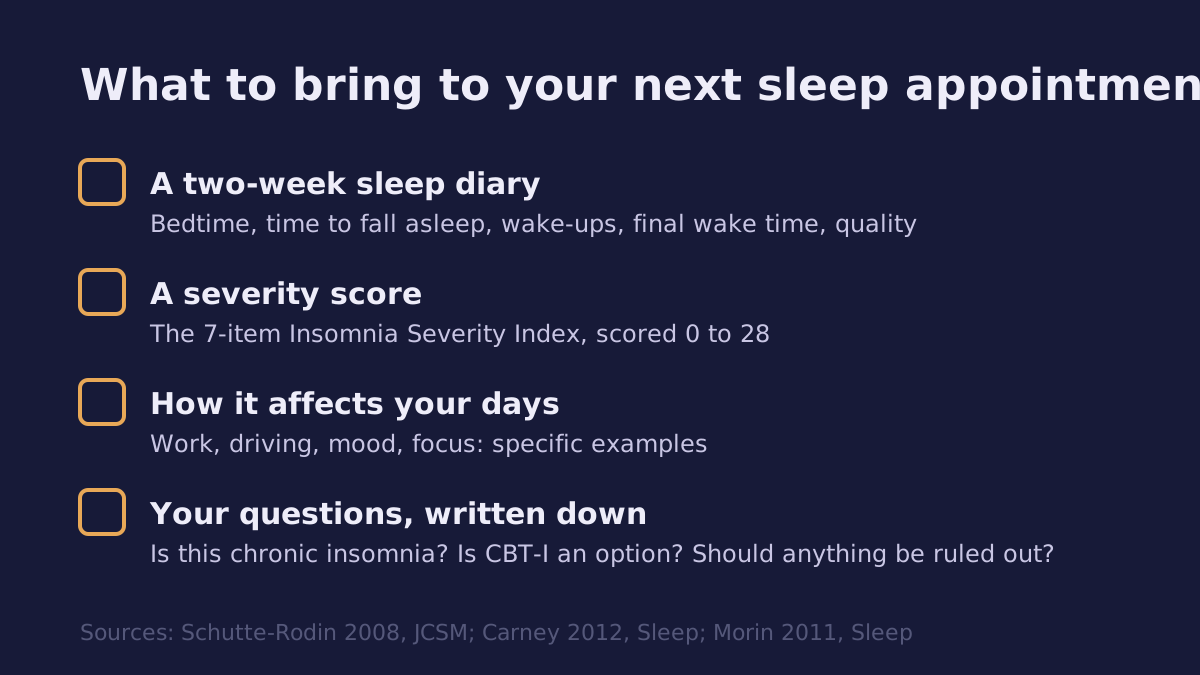 Sources: Schutte-Rodin et al., 2008, Journal of Clinical Sleep Medicine; Carney et al., 2012, Sleep; Morin et al., 2011, Sleep
Step 1: Keep a sleep diary for two weeks
The American Academy of Sleep Medicine's guideline on evaluating chronic insomnia lists a two-week sleep log as part of the minimum workup, to show sleep patterns and how much they vary from night to night (Schutte-Rodin et al.). Bringing one in does part of that work for your doctor before the appointment starts.
You do not need an app. The Consensus Sleep Diary, developed by a group of insomnia researchers, tracks a short list of items each morning (Carney et al.):
- What time you got into bed
- What time you tried to fall asleep
- How long it took to fall asleep
- How many times you woke up, and for how long in total
- Your final wake-up time and the time you got out of bed
- How you would rate the night's sleep quality
- Notes (caffeine, alcohol, naps, a stressful day)
Fill it in each morning from memory rather than checking the clock overnight. Rough estimates are fine. The point is the pattern across 14 nights, not precision on any one of them.
Step 2: Put a number on it
A score turns "I sleep badly" into something that fits on a chart. The Insomnia Severity Index (ISI) is a 7-item questionnaire with a total from 0 to 28. In a validation study, scores of 0 to 7 indicated no insomnia, 8 to 14 subthreshold insomnia, 15 to 21 moderate insomnia, and 22 to 28 severe insomnia, and a cutoff of 10 best identified insomnia in a community sample (Morin et al.). The consensus review calls the ISI "perhaps most useful" among insomnia questionnaires for primary care (Rosenberg et al.).
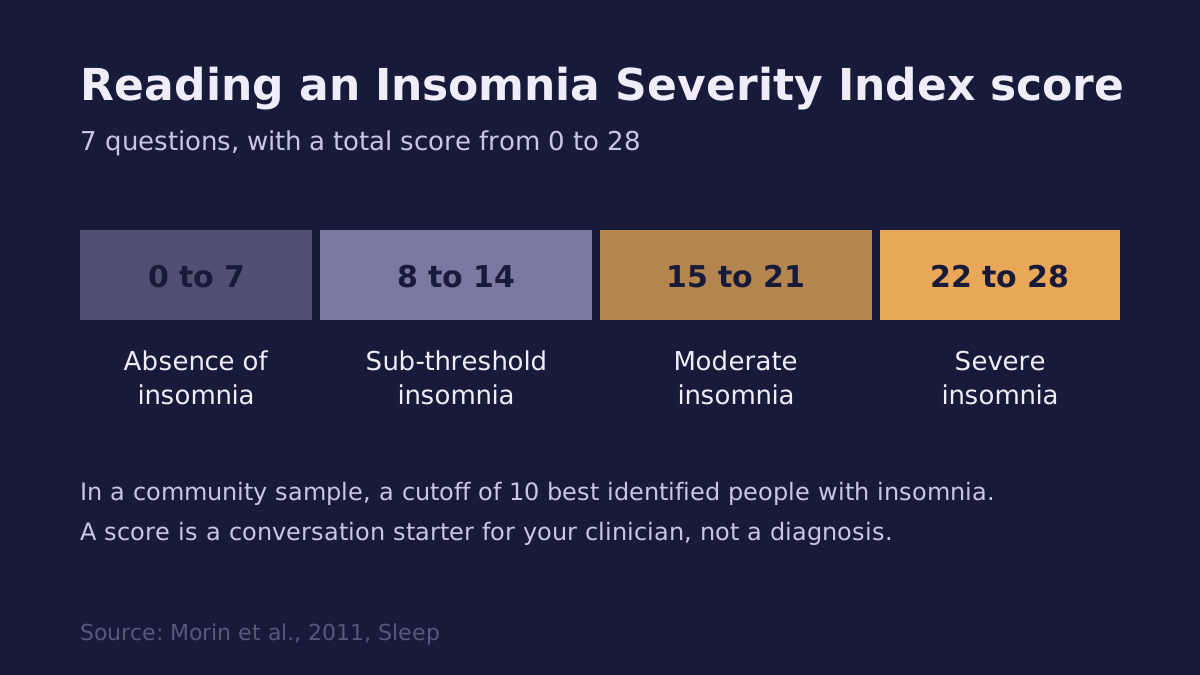 Source: Morin et al., 2011, Sleep
Ask your clinic for the questionnaire, or ask your doctor to give it to you at the visit. Treat the score as a conversation starter, not a diagnosis.
Step 3: Book a visit just for sleep, and lead with your days
When you book, say the appointment is about sleep. That way it does not get squeezed in behind another problem.
Then open with impact, not just hours. The AASM guideline lists daytime function as a core part of the sleep history (Schutte-Rodin et al.). Concrete examples are harder to dismiss than "I'm tired":
- "I've nodded off at red lights twice this month."
- "I've made errors at work I never used to make."
- "This has happened at least three nights a week since March."
Step 4: Ask for specific things
Vague requests get vague answers. Bring these questions written down:
- "Does this meet the criteria for chronic insomnia?" The AASM evaluation guideline describes chronic insomnia as lasting at least a month (Schutte-Rodin et al.).
- "Can you refer me for CBT-I?" The American College of Physicians recommends CBT-I as the initial treatment for all adults with chronic insomnia disorder (Qaseem et al.), and the AASM gives multicomponent CBT-I its only strong recommendation for chronic insomnia (Edinger et al.). A 2015 meta-analysis of 20 trials found that, on average, people fell asleep about 19 minutes sooner and spent about 26 fewer minutes awake during the night after CBT-I (Trauer et al.).
- "Is there anything we should rule out?" Mention snoring, gasping, or leg movements. The AASM evaluation guideline says a sleep study is indicated when there is reasonable suspicion of sleep apnea or a movement disorder, or when treatment has not worked (Schutte-Rodin et al.).
- "What's the plan if this doesn't help?" Ask when to follow up and what would change.
If your doctor's only suggestion was better sleep hygiene, it is fair to ask what comes next. The AASM suggests clinicians not use sleep hygiene by itself as a treatment for chronic insomnia, though it can be part of a broader program (Edinger et al.).
A note on medication
You may also want to ask whether medication is an option. The ACP guideline describes a shared decision about short-term medication, weighing benefits, harms, and costs, for people whose insomnia has not improved with CBT-I alone (Qaseem et al.). Researchers also note that medications for insomnia carry risks of tolerance and side effects (Trauer et al.). Whether any medication is appropriate for you is a decision for a licensed clinician after an evaluation, and a good visit can end without one.
When and where to get a second opinion
If you brought your diary and score, asked specific questions, and still left without a plan or a follow-up, a second opinion is reasonable. Some options:
- Another primary care clinician. A different doctor in the same practice, or a new one, may be more comfortable managing insomnia.
- A sleep medicine specialist. The AASM keeps a directory of accredited sleep centers searchable by location. Check whether your insurance requires a referral first.
- A behavioral sleep medicine provider. These clinicians specialize in CBT-I. The AASM guideline acknowledges that finding a trained CBT-I provider can be hard (Edinger et al.), so the Society of Behavioral Sleep Medicine provider directory is a useful place to start, including for telehealth.
- A telehealth physician. A remote visit can be a way to get a fresh set of eyes on your sleep, especially if local appointments are weeks out.
Bring the same diary and questions to whoever you see next. You will not have to start from scratch.
When it is more than insomnia
Some symptoms call for in-person care rather than another round of questions:
- Loud snoring, gasping, or pauses in breathing a partner has noticed. Ask to be evaluated for sleep apnea; the AASM guideline says a sleep study is indicated when apnea is reasonably suspected (Schutte-Rodin et al.).
- Persistent low mood, loss of interest, or heavy alcohol or substance use alongside poor sleep. Raise these with your doctor or a mental health professional directly.
- Falling asleep while driving. Stop driving drowsy and get seen promptly.
If you are having thoughts of suicide or self-harm, call or text 988 to reach the 988 Suicide and Crisis Lifeline, available 24/7 in the U.S. If you are in immediate danger, call 911.
Frequently asked questions
Is it normal for a doctor to dismiss insomnia?
It is common enough that researchers have studied it. Expert reviews describe insomnia as underdiagnosed and undertreated, and patients in primary care studies report feeling they had to convince clinicians their sleep problem was serious. That does not make it acceptable, but it does mean bringing a diary and specific questions is worth the effort.
How do I ask my doctor for CBT-I?
Say it directly: "I'd like a referral for cognitive behavioral therapy for insomnia." You can note that the American College of Physicians and the American Academy of Sleep Medicine both recommend it for chronic insomnia. If your doctor does not know a local provider, the Society of Behavioral Sleep Medicine directory lists clinicians, including some who offer telehealth.
Do I need a referral to see a sleep specialist?
It depends on your insurance plan. Some plans require a referral from a primary care clinician, while others let you book directly. Call the number on your insurance card or check your plan documents before booking.
How long should I track my sleep before my appointment?
The AASM's evaluation guideline uses a two-week sleep log as part of the minimum workup for chronic insomnia. Two weeks is usually enough to show your typical pattern and how much it varies from night to night.
What if my doctor only tells me to improve my sleep hygiene?
Sleep hygiene tips can help as part of a broader plan, but the AASM suggests clinicians not use sleep hygiene alone to treat chronic insomnia. If you have already tried those changes, say so, and ask about CBT-I or a referral to someone who provides it.
Sources
- Carney CE, Buysse DJ, Ancoli-Israel S, et al. (2012). The Consensus Sleep Diary: standardizing prospective sleep self-monitoring. Sleep. https://doi.org/10.5665/sleep.1642
- Dyas JV, Apekey TA, Tilling M, et al. (2010). Patients' and clinicians' experiences of consultations in primary care for sleep problems and insomnia: a focus group study. British Journal of General Practice. https://doi.org/10.3399/bjgp10X484183
- Edinger JD, Arnedt JT, Bertisch SM, et al. (2021). Behavioral and psychological treatments for chronic insomnia disorder in adults: an American Academy of Sleep Medicine clinical practice guideline. Journal of Clinical Sleep Medicine. https://doi.org/10.5664/jcsm.8986
- Haycock J, Grivell N, Redman A, et al. (2021). Primary care management of chronic insomnia: a qualitative analysis of the attitudes and experiences of Australian general practitioners. BMC Family Practice. https://doi.org/10.1186/s12875-021-01510-z
- Morin CM, Belleville G, Bélanger L, Ivers H. (2011). The Insomnia Severity Index: psychometric indicators to detect insomnia cases and evaluate treatment response. Sleep. https://doi.org/10.1093/sleep/34.5.601
- Qaseem A, Kansagara D, Forciea MA, et al. (2016). Management of chronic insomnia disorder in adults: a clinical practice guideline from the American College of Physicians. Annals of Internal Medicine. https://doi.org/10.7326/M15-2175
- Rosenberg RP, Benca R, Doghramji P, et al. (2023). A 2023 update on managing insomnia in primary care: insights from an expert consensus group. The Primary Care Companion for CNS Disorders. https://doi.org/10.4088/PCC.22nr03385
- Schutte-Rodin S, Broch L, Buysse D, Dorsey C, Sateia M. (2008). Clinical guideline for the evaluation and management of chronic insomnia in adults. Journal of Clinical Sleep Medicine. https://pmc.ncbi.nlm.nih.gov/articles/PMC2576317/
- Trauer JM, Qian MY, Doyle JS, et al. (2015). Cognitive behavioral therapy for chronic insomnia: a systematic review and meta-analysis. Annals of Internal Medicine. https://doi.org/10.7326/M14-2841
This article is for general education and is not medical advice. Talk with a licensed clinician about your own symptoms before starting, stopping, or changing any treatment.