October 28, 2026
Not Sleeping Through the Night? 4 Research-Backed Reasons
By the My Circadian Health editorial team. Reviewed by Brandon Korenek, Founder.
Why you are not sleeping through the night
If you drop off within minutes but find yourself staring at the ceiling at 2 or 3 a.m., you have a different problem than someone who cannot fall asleep. Not sleeping through the night, what clinicians call sleep-maintenance difficulty, usually comes down to one of two things: something is making your sleep shallower than it should be, or something is actively pulling you out of it.
The four causes with the strongest research behind them are alcohol and caffeine timing, a stress-driven state of hyperarousal, the normal changes in sleep that come with age (including nighttime bathroom trips), and untreated sleep apnea. For each, this article covers why it fragments sleep, how to tell whether it fits you, and what research suggests may help.
Reason 1: Alcohol or caffeine too close to bedtime
Alcohol knocks you out, then wakes you up
Alcohol does work for the first part of the night. A 2013 review in Alcoholism: Clinical and Experimental Research (Ebrahim et al.) found that alcohol shortens the time it takes to fall asleep at every dose studied and increases deep slow-wave sleep in the first half of the night. The catch comes later. As the alcohol is cleared, the second half of the night becomes more disrupted, and total REM sleep drops at moderate and high doses.
That is why a few drinks at dinner can leave you wide awake at 3 a.m.
What research suggests may help: the evidence points to dose and timing. Fewer drinks, and more hours between the last one and bed, means less alcohol still being processed in the lighter second half of the night. If cutting back is hard, talk with a clinician rather than working through it alone.
Caffeine lasts longer than it feels like it does
In a randomized trial in the Journal of Clinical Sleep Medicine (Drake et al., 2013), 400 mg of caffeine taken at bedtime, three hours before bed, or six hours before bed each significantly disturbed sleep compared with placebo. The authors concluded that substantial caffeine should be avoided for at least six hours before bedtime.
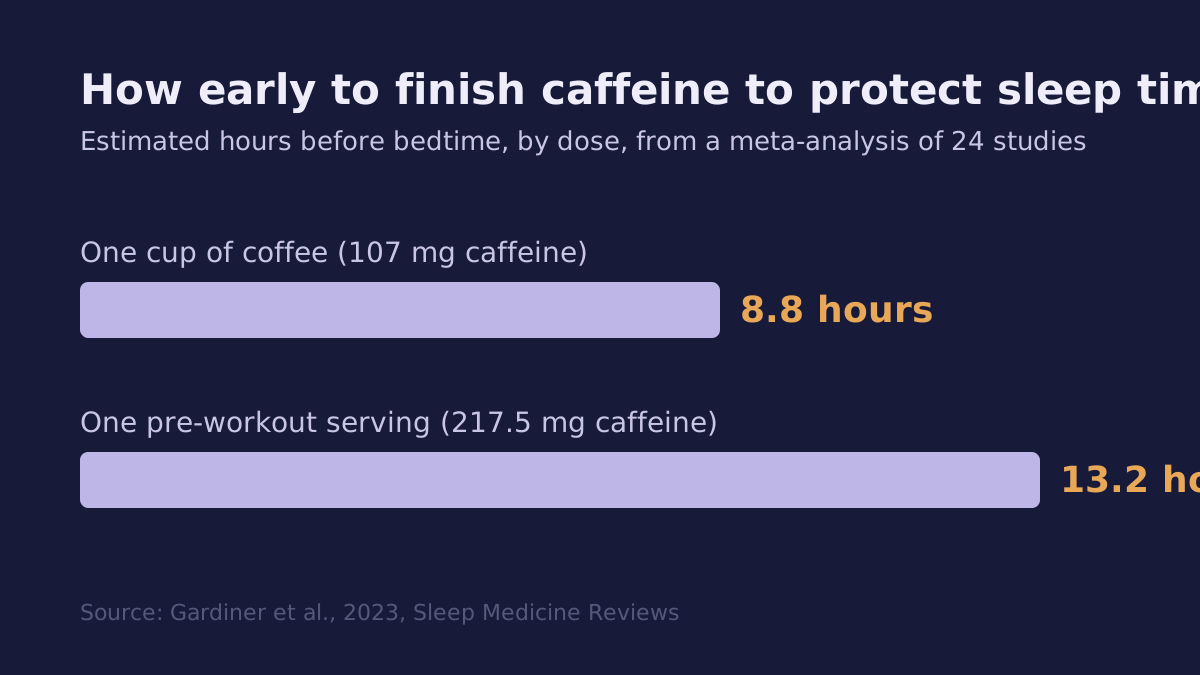
A 2023 meta-analysis of 24 studies in Sleep Medicine Reviews (Gardiner et al.) found that caffeine cut total sleep time by about 45 minutes, lowered sleep efficiency by about 7 percent, and added roughly 12 minutes of time awake after falling asleep. To avoid losing total sleep time, the authors estimated that a standard cup of coffee (107 mg) should be finished at least 8.8 hours before bed, and a typical pre-workout serving (217.5 mg) at least 13.2 hours before.
 Source: Gardiner et al., 2023, Sleep Medicine Reviews
What research suggests may help: move your last caffeine to before early afternoon, and look for the sources that do not announce themselves, such as tea, soda, energy drinks, chocolate, and pre-workout powders.
Reason 2: Stress and a brain that will not idle down
Sleep researchers call this hyperarousal. A review in Sleep Medicine Reviews (Riemann et al., 2010) summarized evidence that people with insomnia show elevated arousal across autonomic, hormonal, and brain-activity measures, both at night and during the day. Worry and rumination feed it, and so do learned associations: after enough frustrating nights, the bed itself becomes a cue for being alert.
Why it fragments sleep: a nervous system running at a higher idle is easier to pull fully awake at the transitions between sleep cycles, which get lighter as the night goes on. Once awake, that same system has a ready supply of problems to work on, and the clock becomes one of them.
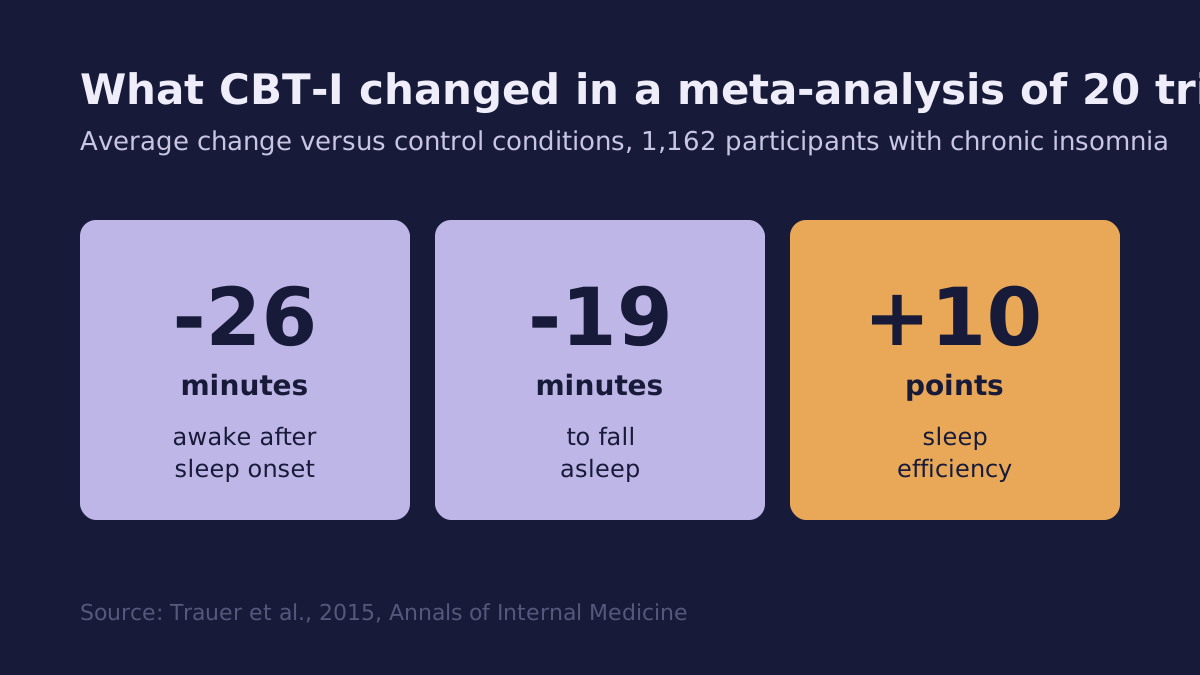
What research suggests may help: cognitive behavioral therapy for insomnia (CBT-I) has the most support for this kind of waking. A 2015 meta-analysis in Annals of Internal Medicine (Trauer et al.) covering 20 trials and 1,162 participants found that CBT-I reduced time awake after sleep onset by about 26 minutes, shortened time to fall asleep by about 19 minutes, and improved sleep efficiency by about 10 percentage points, with no adverse outcomes reported. The American Academy of Sleep Medicine's 2021 guideline (Edinger et al.) gives multicomponent CBT-I a strong recommendation for chronic insomnia and suggests against relying on sleep hygiene advice alone.
 Source: Trauer et al., 2015, Annals of Internal Medicine
CBT-I typically combines getting out of bed when you are awake and frustrated, temporarily compressing time in bed so sleep consolidates, and working directly on the worry loop. It is usually delivered by a trained clinician or a structured program.
If stress-related waking comes with persistent low mood, anxiety that does not lift, or thoughts of harming yourself, please see a clinician in person. In the U.S., you can call or text 988 to reach the Suicide and Crisis Lifeline at any hour.
Reason 3: Your sleep has changed with age
This one is not a disorder, but it is real and it is large. A meta-analysis in Sleep (Ohayon et al., 2004) pooled sleep-lab data from healthy people across the lifespan and found that in adults, total sleep time, sleep efficiency, and the shares of deep slow-wave sleep and REM sleep all decline with age, while time awake after sleep onset increases significantly. Sleep efficiency was still falling after age 60.
A 2017 review in Neuron (Mander, Winer, and Walker) describes the same picture: compared with younger adults, older adults show more fragmented sleep, more shifts into lighter stages, and less slow-wave sleep, particularly early in the night. The authors ask whether older adults need less sleep or are less able to generate the sleep they still need, and lean toward the second, pointing to a weaker, slower build-up of sleep pressure with age.
The bathroom trip that steals the night
Age-related waking often has a practical trigger. In a study of 1,424 U.S. adults aged 55 to 84 in Sleep Medicine (Bliwise et al., 2009), 53 percent said getting up to urinate disturbed their sleep every night or almost every night, more than four times the next most common cause, pain, at 12 percent. Nocturia independently predicted self-reported insomnia (about 75 percent higher risk) and reduced sleep quality (about 71 percent higher risk).
What research suggests may help: because deep sleep is thinner and sleep pressure builds more weakly, the basics carry more weight than they did at 25. Light, noise, temperature, and long or late naps are worth an honest look. For nocturia, shifting more of your fluids earlier in the day is a reasonable first step, but frequent nighttime urination also deserves a conversation with a physician, because it can have treatable causes, and the National Heart, Lung, and Blood Institute lists it among the symptoms of sleep apnea.
Reason 4: Untreated sleep apnea
Obstructive sleep apnea is far more common than most people assume. A 2019 analysis in The Lancet Respiratory Medicine (Benjafield et al.) estimated that about 936 million adults aged 30 to 69 worldwide have at least mild obstructive sleep apnea, and about 425 million have moderate-to-severe disease.
Why it fragments sleep: during an apnea event the upper airway narrows or closes, breathing pauses, and the brain briefly rouses to reopen it. Most of these arousals are too short to remember. According to the NHLBI, signs include breathing that starts and stops during sleep, frequent loud snoring, gasping for air, daytime sleepiness and tiredness, headache, dry mouth, and waking up often to urinate. The NHLBI also lists insomnia itself as a symptom, more commonly in women, so it can be missed in people who complain about sleep rather than snoring.
What research suggests may help: this is the one cause you cannot sort out from an article. Diagnosis requires objective sleep testing, and the American Academy of Sleep Medicine's 2019 guideline (Patil et al.) strongly recommends positive airway pressure (PAP) therapy over no treatment for adults with obstructive sleep apnea and excessive sleepiness, with conditional suggestions for those with impaired sleep-related quality of life or high blood pressure. If a bed partner has heard you stop breathing, or snoring and daytime sleepiness are part of your picture, see your primary care doctor or a sleep clinic in person and ask about a sleep study.
How to figure out which one is yours
A two-week log narrows it down faster than guessing. Each morning, note when you got into bed, when you woke and for how long, what you drank after noon, and how you felt by mid-afternoon. Then look for the signatures:
- Waking three to four hours after a night with alcohol, easing on dry nights, points to Reason 1.
- Waking with a racing mind, checking the clock, and dreading the bed points to Reason 2.
- Being over 60, waking to use the bathroom, and otherwise feeling reasonably rested points to Reason 3.
- Snoring, gasping, or sleepiness heavy enough to nod off while sitting points to Reason 4 and an in-person evaluation.
When to talk with a physician
If you have adjusted caffeine and alcohol, given it a few weeks, and the waking continues, or if it has gone on for months and is affecting your days, the next step is a conversation with a licensed clinician. A physician can help sort out which cause fits and discuss options, which may include a referral for CBT-I, a sleep study if apnea is possible, or, only when clinically appropriate after an evaluation, medication.
Frequently asked questions
Why do I wake up at 3 a.m. every night?
Sleep gets lighter in the second half of the night, so anything that lowers your threshold for waking tends to show up then. The most common contributors are evening alcohol, which disrupts the second half of the night as it clears, stress-driven hyperarousal, and the lighter, more fragmented sleep that comes with age.
Is it normal to wake up during the night?
Yes. Brief awakenings at the end of each sleep cycle are part of normal sleep, and most people do not remember them. Waking becomes a problem when you notice it regularly, stay awake for a long stretch, or feel tired the next day.
How many hours before bed should I stop drinking coffee?
A randomized trial found that 400 mg of caffeine six hours before bed still significantly disturbed sleep, and its authors recommended at least a six-hour buffer. A 2023 meta-analysis estimated about 8.8 hours for a standard cup of coffee to avoid losing total sleep time. If you are waking at night, an early-afternoon cutoff is a conservative place to start.
Can sleep apnea cause insomnia?
It can look like insomnia. The NHLBI lists insomnia among the symptoms of sleep apnea, more commonly in women, along with waking often to urinate, headache, and daytime sleepiness. Snoring, gasping, or a partner noticing pauses in breathing are reasons to ask a doctor about a sleep study.
Sources
- Ebrahim IO, Shapiro CM, Williams AJ, Fenwick PB. 2013. Alcohol and sleep I: effects on normal sleep. Alcoholism: Clinical and Experimental Research. https://doi.org/10.1111/acer.12006
- Drake C, Roehrs T, Shambroom J, Roth T. 2013. Caffeine effects on sleep taken 0, 3, or 6 hours before going to bed. Journal of Clinical Sleep Medicine. https://doi.org/10.5664/jcsm.3170
- Gardiner C, et al. 2023. The effect of caffeine on subsequent sleep: a systematic review and meta-analysis. Sleep Medicine Reviews. https://doi.org/10.1016/j.smrv.2023.101764
- Riemann D, Spiegelhalder K, Feige B, et al. 2010. The hyperarousal model of insomnia: a review of the concept and its evidence. Sleep Medicine Reviews. https://doi.org/10.1016/j.smrv.2009.04.002
- Trauer JM, Qian MY, Doyle JS, Rajaratnam SMW, Cunnington D. 2015. Cognitive behavioral therapy for chronic insomnia: a systematic review and meta-analysis. Annals of Internal Medicine. https://doi.org/10.7326/M14-2841
- Edinger JD, Arnedt JT, Bertisch SM, et al. 2021. Behavioral and psychological treatments for chronic insomnia disorder in adults: an AASM clinical practice guideline. Journal of Clinical Sleep Medicine. https://doi.org/10.5664/jcsm.8986
- Ohayon MM, Carskadon MA, Guilleminault C, Vitiello MV. 2004. Meta-analysis of quantitative sleep parameters from childhood to old age in healthy individuals. Sleep. https://doi.org/10.1093/sleep/27.7.1255
- Mander BA, Winer JR, Walker MP. 2017. Sleep and human aging. Neuron. https://doi.org/10.1016/j.neuron.2017.02.004
- Bliwise DL, Foley DJ, Vitiello MV, Ansari FP, Ancoli-Israel S, Walsh JK. 2009. Nocturia and disturbed sleep in the elderly. Sleep Medicine. https://doi.org/10.1016/j.sleep.2008.04.002
- Benjafield AV, et al. 2019. Estimation of the global prevalence and burden of obstructive sleep apnoea: a literature-based analysis. The Lancet Respiratory Medicine. https://doi.org/10.1016/S2213-2600(19)30198-5
- Patil SP, Ayappa IA, Caples SM, Kimoff RJ, Patel SR, Harrod CG. 2019. Treatment of adult obstructive sleep apnea with positive airway pressure: an AASM clinical practice guideline. Journal of Clinical Sleep Medicine. https://doi.org/10.5664/jcsm.7640
- National Heart, Lung, and Blood Institute. Sleep apnea: symptoms. https://www.nhlbi.nih.gov/health/sleep-apnea/symptoms
This article is for general education and is not medical advice. Talk with a licensed clinician about your own symptoms before starting, stopping, or changing any treatment.