November 2, 2026
Insomnia Affecting Your Job? What to Do Next
By the My Circadian Health editorial team. Reviewed by Brandon Korenek, Founder.
The short answer
If insomnia is affecting your job, do three things. First, work out whether this is a rough patch or a pattern by keeping a simple sleep diary for two weeks. Second, start the core habits from cognitive behavioral therapy for insomnia (CBT-I), which major U.S. guidelines recommend as the first treatment for chronic insomnia. Third, see a doctor if the problem happens three or more nights a week for more than three months, or sooner if your sleep is making your work unsafe.
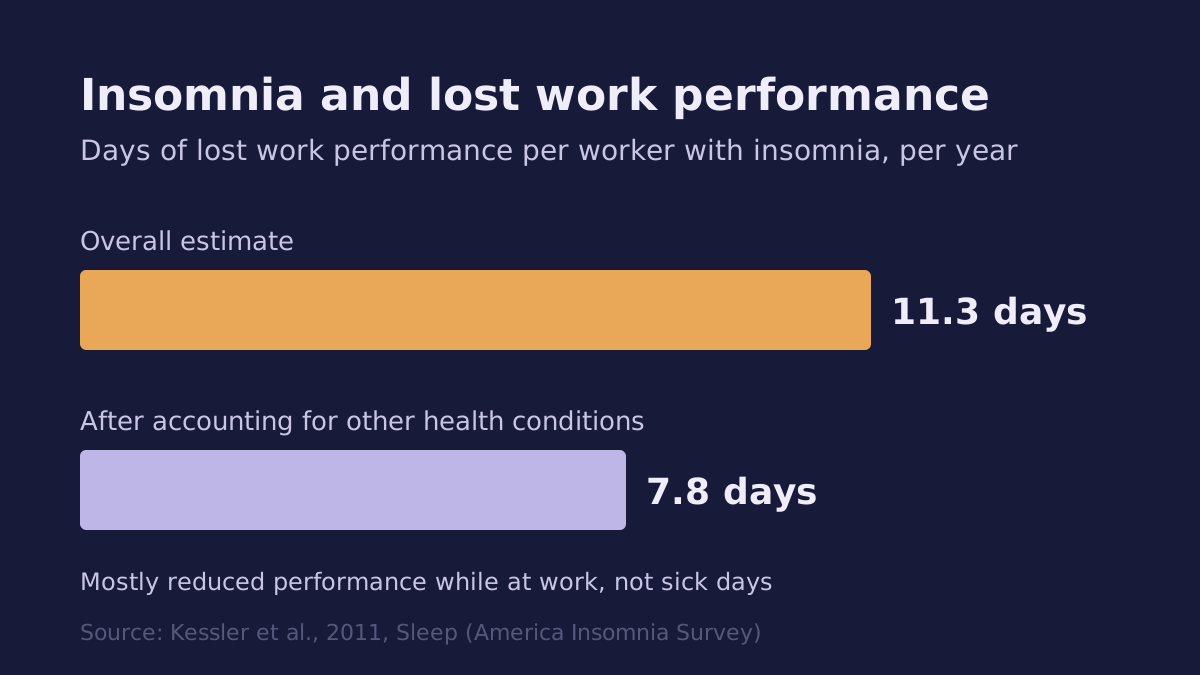
You are not imagining the effect on your work, and you are not alone. In a national survey of more than 7,400 employed U.S. adults, 23.2% met criteria for insomnia, and insomnia was linked to the equivalent of 11.3 days of lost work performance per worker each year (Kessler et al., 2011). Most of that loss came from people who showed up but could not work at their usual level, not from sick days.
How insomnia shows up at work
The same survey found that insomnia was tied to presenteeism (being at work but performing below your normal level) rather than absenteeism (Kessler et al., 2011). That matches what many people describe: rereading the same email three times, losing words in meetings, a shorter fuse with coworkers, and a 2 p.m. slump that coffee no longer fixes.
 Source: Kessler et al., 2011, Sleep (America Insomnia Survey)
Part of that loss overlaps with other health problems people with insomnia often have. When the researchers accounted for those conditions, the estimate dropped to 7.8 days a year, still worth about $2,280 per worker in lost output.
Mistakes matter too. A follow-up analysis of the same survey found that workers with insomnia had about 1.4 times the odds of a costly workplace accident or error, even after controlling for other chronic conditions (Shahly et al., 2012). If your job involves driving, machinery, patient care, or other safety-sensitive work, that changes how long you should wait before getting help.
Rough patch or chronic insomnia?
The National Heart, Lung, and Blood Institute separates insomnia into two kinds (NHLBI):
- Short-term (acute) insomnia lasts a few days or weeks. It is often set off by stress, a schedule change, or a new environment. A product launch, a new manager, or a stretch of late shifts can all do it.
- Chronic insomnia happens three or more nights a week, lasts more than three months, and cannot be fully explained by another health problem.
This is why a sleep diary helps. Each morning, write down roughly when you went to bed, how long it took to fall asleep, how long you were awake during the night, when you got up, and how you felt at work that day. After two weeks you will have a clearer picture than memory can give you, and it is exactly what a clinician will ask about.
What to try first: the core of CBT-I
The American College of Physicians gives a strong recommendation that adults with chronic insomnia receive CBT-I as the first treatment (Qaseem et al., 2016). The American Academy of Sleep Medicine also strongly recommends multicomponent CBT-I (Edinger et al., 2021).
CBT-I is not the same as sleep hygiene tips. The AASM guideline actually suggests against using sleep hygiene on its own as a treatment (Edinger et al., 2021). CBT-I combines several techniques, most often guided by a trained clinician or a structured program:
Stimulus control
Use the bed for sleep (and sex) only. If you are lying awake and frustrated, get up, go to another room, and do something quiet until you feel sleepy. The goal is to re-teach your brain that bed means sleep, not answering Slack or replaying a meeting. The AASM conditionally suggests stimulus control even as a stand-alone therapy.
Sleep restriction
This means matching your time in bed to the amount you are actually sleeping, then widening it as your sleep consolidates. It feels backwards when you are already tired, which is one reason it is best done with guidance, especially if your work is safety-sensitive. The AASM conditionally suggests sleep restriction as a stand-alone therapy as well.
Relaxation and the thinking side
Relaxation methods and work on the thoughts that keep you up ("If I don't sleep tonight, tomorrow's presentation is ruined") are also part of CBT-I. Work worry is one of the most common fuels for this cycle.
Does it work, and does it help at work?
A 2015 meta-analysis of 20 randomized trials with 1,162 adults found that CBT-I improved how long it took to fall asleep, time awake during the night, and sleep efficiency, with gains that held at later follow-up (Trauer et al., 2015).
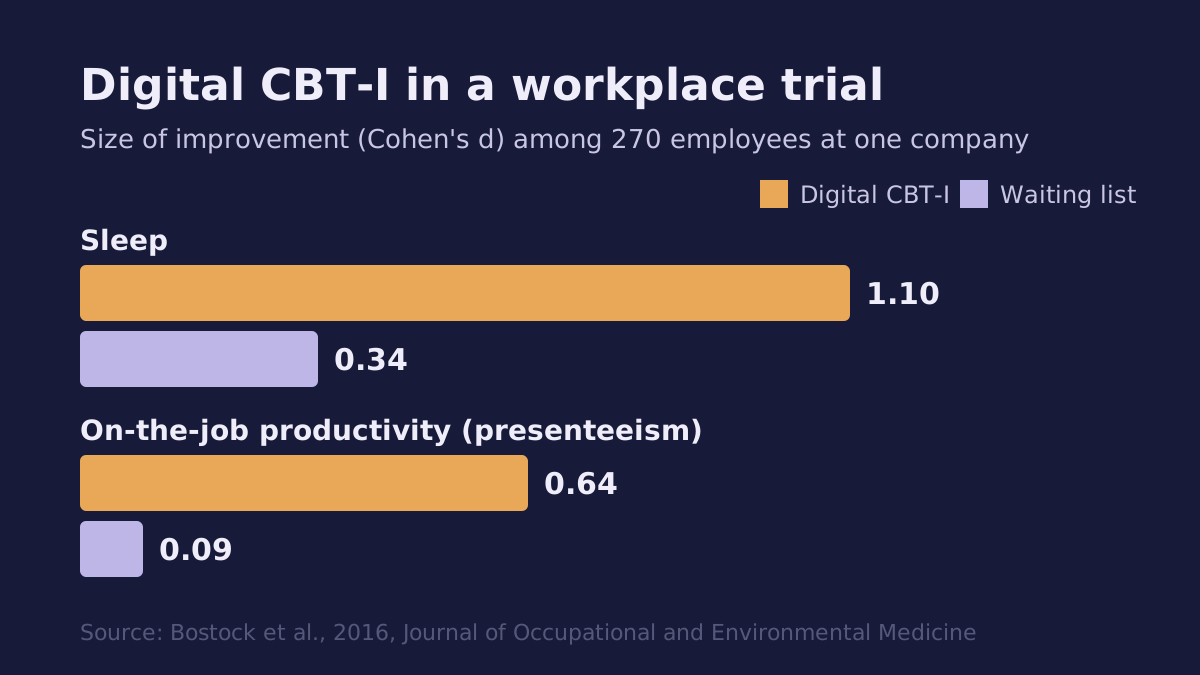
There is also workplace-specific evidence. In a randomized trial at a Fortune 500 company, 270 employees who described themselves as poor sleepers were assigned to a six-session digital CBT-I program or a waiting list (Bostock et al., 2016). The digital CBT-I group showed larger improvements in sleep and in presenteeism. The difference in sick days was not statistically significant.
 Source: Bostock et al., 2016, Journal of Occupational and Environmental Medicine
Results vary from person to person.
Asking for help at work
You do not have to choose between pushing through silently and telling your manager everything. Some middle-ground options:
- Ask about practical adjustments. The Job Accommodation Network (JAN) lists accommodation ideas for sleep-related limitations, including a flexible schedule, a modified break schedule, periodic rest breaks, and telework (JAN). JAN notes that accommodations may help people adjust during treatment or to new sleep patterns.
- Know how the ADA works. JAN explains that the Americans with Disabilities Act has no fixed list of qualifying conditions. Whether a condition counts depends on whether it substantially limits a major life activity, so it is decided case by case. Your HR team can explain how the process works where you are.
- Check your benefits. Many employers offer an employee assistance program or a digital sleep program through their health plan. It is worth asking HR what is available.
You choose how much to share. "I'm dealing with a health issue that affects my sleep and I'm getting it treated" is often enough.
When to see a doctor
Book an appointment if any of these apply:
- Your sleep trouble happens three or more nights a week and has lasted more than three months, matching the NHLBI description of chronic insomnia (NHLBI).
- You have tried the habits above for a few weeks and your days at work are not improving.
- You work in a safety-sensitive role and feel drowsy or make errors on the job. Do not wait three months for this one.
- You snore loudly and often, someone has seen your breathing stop and start in your sleep, or you wake up gasping for air. These are listed symptoms of sleep apnea (NHLBI), which needs an in-person evaluation and often a sleep study.
- Low mood, anxiety, or alcohol or other substance use is part of the picture. Those deserve their own care alongside sleep treatment, ideally with a clinician who can see you in person.
If you are having thoughts of harming yourself, call or text 988 to reach the 988 Suicide and Crisis Lifeline, available 24 hours a day.
A clinician can look for medical causes, review medications or caffeine and alcohol habits that may be affecting your sleep, and connect you with CBT-I. Medication is sometimes discussed too. The ACP guideline suggests that when CBT-I alone has not worked, clinicians and patients decide together whether to add short-term medication, weighing benefits, harms, and costs, and it rates the evidence for that step as low quality (Qaseem et al., 2016). Some sleep medications, including several sedative-hypnotics, are controlled substances with real risks. Whether any medication is appropriate for you is a decision for a licensed clinician after an evaluation.
Frequently asked questions
Should I tell my boss I have insomnia?
That is your choice. If you want an accommodation such as a flexible schedule, you will need to share enough for your employer to understand the request. Many people keep it brief and focus on what would help them do the job well.
Is insomnia considered a disability under the ADA?
There is no automatic answer. According to the Job Accommodation Network, the ADA has no definitive list of conditions, and what matters is whether an impairment substantially limits one or more major life activities (JAN). Your HR team can explain how requests are handled where you work.
Can poor sleep really make me worse at my job?
Research suggests it can. In the America Insomnia Survey, insomnia was linked to the equivalent of 11.3 days of lost work performance per worker per year, mostly from reduced performance while at work (Kessler et al., 2011). It was also associated with higher odds of costly workplace accidents and errors (Shahly et al., 2012).
How long does CBT-I take?
CBT-I is delivered as a series of sessions rather than a single visit. The workplace trial above used six online sessions (Bostock et al., 2016), and the meta-analysis found improvements held at later follow-up (Trauer et al., 2015).
Can I ask to work from home because of insomnia?
You can ask. Telework and flexible scheduling both appear on the Job Accommodation Network's list of accommodation ideas for sleep-related limitations (JAN). Whether your employer must grant it depends on your situation and the ADA process.
Sources
- Bostock S, Luik AI, Espie CA. 2016. Sleep and productivity benefits of digital cognitive behavioral therapy for insomnia: a randomized controlled trial conducted in the workplace environment. Journal of Occupational and Environmental Medicine. https://doi.org/10.1097/JOM.0000000000000778
- Edinger JD, et al. 2021. Behavioral and psychological treatments for chronic insomnia disorder in adults: an American Academy of Sleep Medicine clinical practice guideline. Journal of Clinical Sleep Medicine. https://doi.org/10.5664/jcsm.8986
- Job Accommodation Network. Sleep Disorders. https://askjan.org/disabilities/Sleep-Disorder.cfm
- Kessler RC, et al. 2011. Insomnia and the performance of US workers: results from the America Insomnia Survey. Sleep. https://doi.org/10.5665/sleep.1230
- National Heart, Lung, and Blood Institute. Insomnia. https://www.nhlbi.nih.gov/health/insomnia
- National Heart, Lung, and Blood Institute. Sleep Apnea: Symptoms. https://www.nhlbi.nih.gov/health/sleep-apnea/symptoms
- Qaseem A, et al. 2016. Management of chronic insomnia disorder in adults: a clinical practice guideline from the American College of Physicians. Annals of Internal Medicine. https://doi.org/10.7326/M15-2175
- Shahly V, et al. 2012. The associations of insomnia with costly workplace accidents and errors: results from the America Insomnia Survey. Archives of General Psychiatry. https://doi.org/10.1001/archgenpsychiatry.2011.2188
- Trauer JM, et al. 2015. Cognitive behavioral therapy for chronic insomnia: a systematic review and meta-analysis. Annals of Internal Medicine. https://doi.org/10.7326/M14-2841
This article is for general education and is not medical advice. Talk with a licensed clinician about your own symptoms before starting, stopping, or changing any treatment.