November 5, 2026
Insomnia After a Stressful Event That Never Went Away
By the My Circadian Health editorial team. Reviewed by Brandon Korenek, Founder.

Why insomnia after a stressful event can stick around
A breakup, a layoff, a death in the family, a move, a scary diagnosis. Something hard happened, and your sleep fell apart. That part made sense. What doesn't make sense is that the crisis is over, or at least calmer, and you still lie awake. If your insomnia started after a stressful event and never went away, you are not imagining the pattern, and you are not broken.
The short answer is that the stressful event started the insomnia, but something else is now keeping it going. Sleep researchers call these "perpetuating factors": habits and thought patterns that grow up around bad nights, such as spending extra time in bed, sleeping in, napping, and worrying about sleep itself. Those factors can keep insomnia alive long after the original stress has faded. The encouraging part is that they are learned patterns, and the treatments built to undo them have strong research behind them.
Most stress-related insomnia fades. Some doesn't.
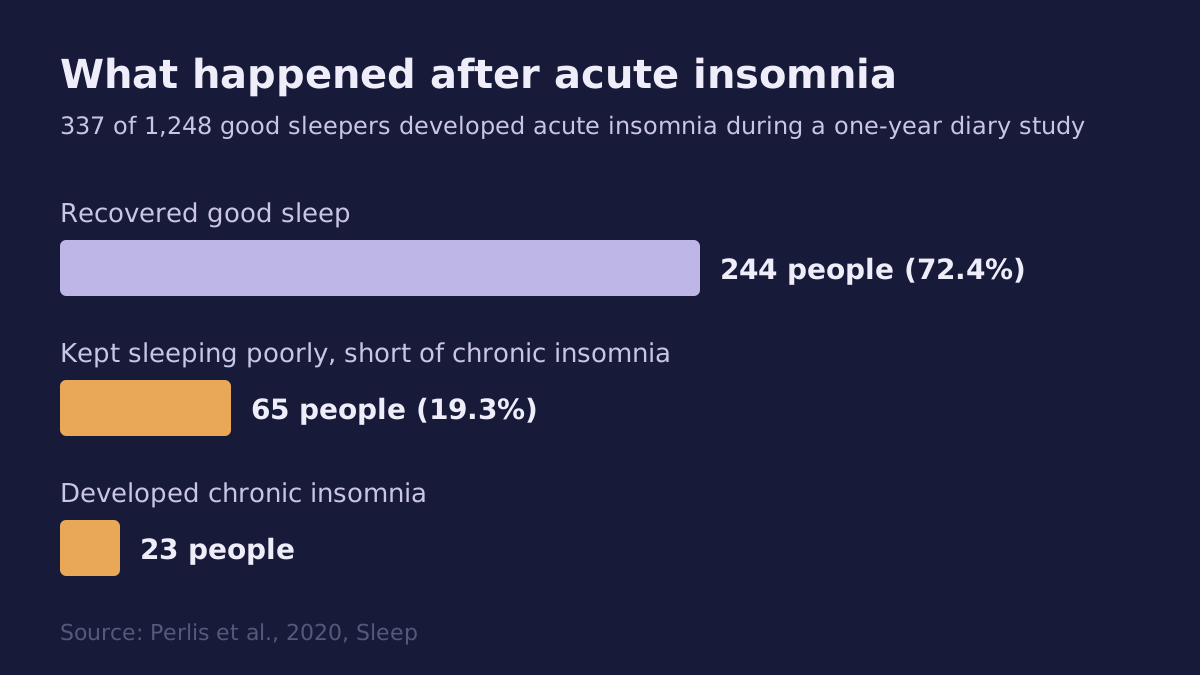
Short bouts of bad sleep are common. In a 2020 study in Sleep, researchers followed 1,248 good sleepers with daily sleep diaries for a year (Perlis et al.). Over that year, 27.0% developed acute insomnia, meaning poor sleep at least three nights a week for two to twelve weeks. Of those 337 people, 72.4% went back to sleeping well. But 19.3% kept sleeping poorly without quite meeting the definition of chronic insomnia, and 23 people (1.8% of the whole group) developed chronic insomnia.
 Source: Perlis et al., 2020, Sleep
So recovery is the most common outcome. If you are reading this months after the event, though, you may be in the smaller group, and that group deserves a real plan rather than more waiting.
Once insomnia settles in, it tends to stay. A three-year study of 388 adults with insomnia in Archives of Internal Medicine found that 74% still had insomnia a year later and 46% had it for the full three years (Morin et al., 2009). Persistence was more likely when insomnia was more severe at the start. Among people whose insomnia did remit, 27% later relapsed.
The 3P model: predisposing, precipitating, perpetuating
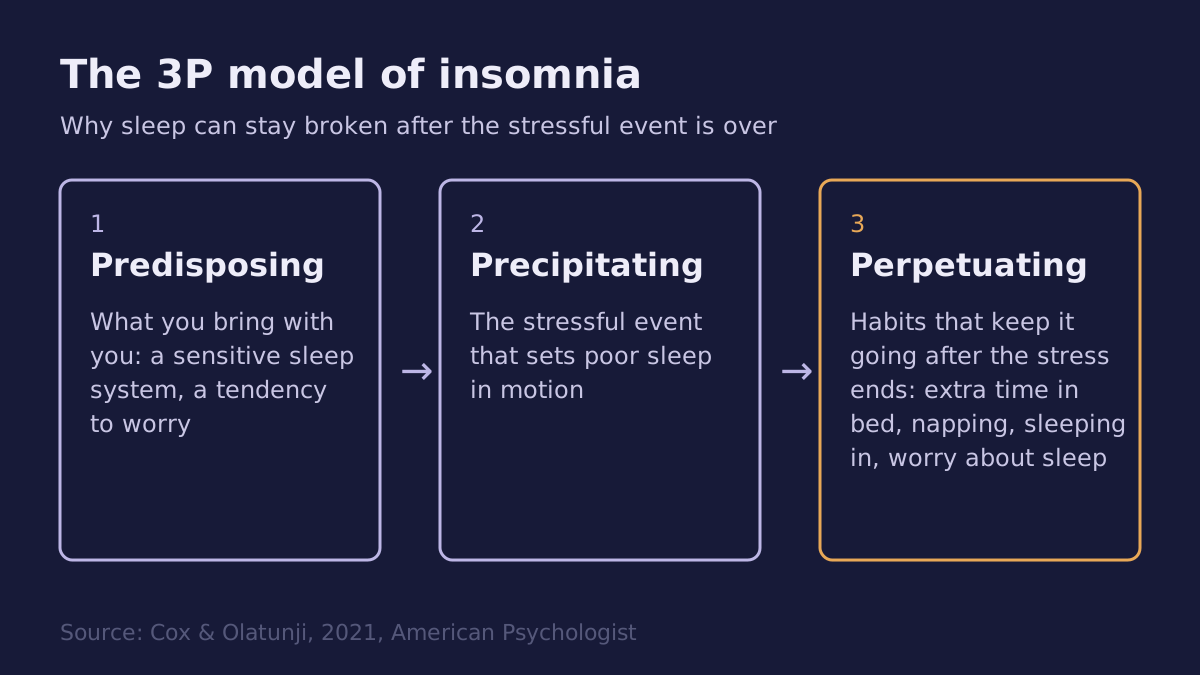
The most widely used way to explain this is the "3P model" of insomnia. A 2021 review in American Psychologist summarizes it (Cox & Olatunji):
- Predisposing factors are the vulnerabilities you brought with you, like a tendency to worry or a sensitive sleep system.
- Precipitating factors are the stressors that set things off. This is your stressful event.
- Perpetuating factors are the behaviors and thoughts that maintain poor sleep "even following the offset of the precipitating factor."
 Source: Cox & Olatunji, 2021, American Psychologist
That third P is the answer to "why hasn't it gone away?" The stressor lit the match. The perpetuating factors are what keep the fire going.
Some sleep systems react more strongly to stress
Not everyone loses sleep the same way when life gets hard. Researchers call this trait "sleep reactivity": how much stress disrupts a person's sleep. A 2018 review in the Journal of Sleep Research describes how people with highly reactive sleep systems sleep much worse under stress, and how high sleep reactivity predicts future insomnia (Kalmbach et al.). The same review notes that worry and rumination may take advantage of a sensitive sleep system and make things worse.
If you have always been a light sleeper before big exams or trips, this may describe you. It is not a character flaw. It is a trait, and it helps explain why the same event might leave a partner sleeping fine while you lie awake.
What keeps insomnia going after the stress ends
Here are the perpetuating factors the 3P literature describes most often (Cox & Olatunji, 2021). Read them as a checklist. Most people months into insomnia will recognize several.
Spending more time in bed to catch up
Going to bed early, sleeping in, and napping all feel sensible after a bad night. The problem is that they spread a limited amount of sleep across a longer window, so you spend more time lying awake. In a 2021 follow-up of the same diary study, the group that went on to develop chronic insomnia had the highest share of people who expanded their time in bed (39.1%) in the weeks around onset (Perlis et al.). The authors are careful to say this did not prove extra time in bed alone drives the shift to chronic insomnia, so treat it as one piece of the picture rather than the whole story.
The bed becoming a place for being awake
When you spend night after night in bed frustrated, scrolling, or replaying the day, your brain can start to link the bed with alertness rather than sleep. Cox and Olatunji describe this as the bed becoming "a conditioned stimulus for arousal." A common sign: you feel sleepy on the couch, then wide awake the moment your head hits the pillow.
Worrying about sleep itself
At first you were lying awake thinking about the event. Now you may be lying awake thinking about not sleeping: how tired you will be tomorrow, whether something is wrong with you, how many hours are left. The review lists excessive worry, watching closely for signs of wakefulness, and distorted beliefs about sleep as perpetuating factors.
What to do if you are months in
If your insomnia began after a stressful event and has lasted three months or longer, it is time to treat the insomnia directly instead of waiting for the stress to finish its work.
Look into cognitive behavioral therapy for insomnia (CBT-I)
CBT-I is a structured, short-term program that targets the perpetuating factors above. It usually combines sleep restriction (matching time in bed to the sleep you are actually getting), stimulus control (getting out of bed when you can't sleep, so the bed is relinked with sleep), and work on unhelpful thoughts about sleep.
The American Academy of Sleep Medicine issued a strong recommendation that clinicians use multicomponent CBT-I to treat chronic insomnia in adults (Edinger et al., 2021). The same guideline suggests against using sleep hygiene tips alone as a treatment, which may explain why "no screens, no caffeine" advice hasn't fixed things for you.
A 2015 meta-analysis of 20 trials in Annals of Internal Medicine found that, compared with inactive comparisons, CBT-I was associated with taking about 19 fewer minutes to fall asleep and spending about 26 fewer minutes awake during the night, with improvements that seemed to last at later follow-ups (Trauer et al.). Results vary from person to person.
If it's still early, even a short intervention may help
If you are only a few weeks past the event, the research on early treatment is encouraging. In a small randomized trial in Sleep, 40 adults with acute insomnia either received a single 60- to 70-minute CBT-I session plus a self-help pamphlet or waited. One month later, 60% of the treated group no longer met the insomnia threshold, compared with 15% of the waitlist group (Ellis et al., 2015). It was a small study, but it suggests you do not have to wait for insomnia to become entrenched before addressing it.
Things you can start tonight
These steps borrow from the components above. They are a starting point, not a substitute for a full program or an evaluation:
- Keep a two-week sleep diary. Note bedtime, rough time to fall asleep, wake-ups, and final wake time. It gives you and any clinician real data rather than a blur of bad nights.
- Fix your wake-up time, including weekends, even after a rough night.
- Get out of bed if you are lying awake and frustrated. Do something calm in dim light, then go back when sleepy.
- Set a "worry time" earlier in the evening. Write down what is on your mind and one next step, so it is not waiting for you at midnight.
- Hold off on long naps and early bedtimes meant to make up for lost sleep.
When to bring in a clinician
Talk with a clinician if insomnia has lasted three months or more, if it is affecting your work, mood, or safety on the road, or if self-help steps have not moved the needle. Some people also ask about medication. Whether any medication is appropriate is a decision for a licensed clinician after an evaluation of your history, other conditions, and current medicines.
If the stressful event was traumatic, or you have nightmares, flashbacks, low mood that won't lift, loud snoring or gasping at night, or you are using alcohol or other substances to sleep, please see a clinician in person. Those can point to conditions such as PTSD, depression, or sleep apnea that need their own evaluation and care.
If you are having thoughts of harming yourself, call or text 988 to reach the 988 Suicide and Crisis Lifeline, available 24 hours a day in the U.S.
Frequently asked questions
Can stress cause long-term insomnia?
Stress is a common trigger, and research suggests most new-onset insomnia resolves within days to weeks. In some people, though, habits such as extra time in bed and worry about sleep keep insomnia going after the stress ends. In one large diary study, 1.8% of good sleepers developed chronic insomnia within a year (Perlis et al., 2020).
How long does insomnia last after a traumatic or stressful event?
It varies. Most people with acute insomnia in the 2020 Sleep study returned to good sleep, but about one in five kept sleeping poorly. Insomnia that lasts three months or longer, at least three nights a week, is generally considered chronic and is worth treating directly.
Why can't I sleep even though I'm not stressed anymore?
The event may have started the insomnia, but perpetuating factors can maintain it. These include spending more time in bed to catch up, the bed becoming linked with being awake, and anxiety about sleep itself (Cox & Olatunji, 2021). These patterns can run on their own once established.
Is CBT-I helpful if my insomnia was caused by stress?
CBT-I targets the habits and thoughts that keep insomnia going, whatever started it. The American Academy of Sleep Medicine strongly recommends it for chronic insomnia in adults (Edinger et al., 2021). A small trial also found a single session may help people with recent-onset insomnia (Ellis et al., 2015).
Sources
- Perlis ML, Vargas I, Ellis JG, et al. (2020). The natural history of insomnia: the incidence of acute insomnia and subsequent progression to chronic insomnia or recovery in good sleeper subjects. Sleep. https://doi.org/10.1093/sleep/zsz299
- Morin CM, Bélanger L, LeBlanc M, et al. (2009). The natural history of insomnia: a population-based 3-year longitudinal study. Archives of Internal Medicine. https://doi.org/10.1001/archinternmed.2008.610
- Cox RC, Olatunji BO. (2021). Sleep in a pandemic: implications of COVID-19 for sleep through the lens of the 3P model of insomnia. American Psychologist. https://doi.org/10.1037/amp0000850
- Kalmbach DA, Anderson JR, Drake CL. (2018). The impact of stress on sleep: pathogenic sleep reactivity as a vulnerability to insomnia and circadian disorders. Journal of Sleep Research. https://doi.org/10.1111/jsr.12710
- Perlis ML, Morales KH, Vargas I, et al. (2021). The natural history of insomnia: does sleep extension differentiate between those that do and do not develop chronic insomnia? Journal of Sleep Research. https://doi.org/10.1111/jsr.13342
- Edinger JD, Arnedt JT, Bertisch SM, et al. (2021). Behavioral and psychological treatments for chronic insomnia disorder in adults: an American Academy of Sleep Medicine clinical practice guideline. Journal of Clinical Sleep Medicine. https://doi.org/10.5664/jcsm.8986
- Trauer JM, Qian MY, Doyle JS, Rajaratnam SM, Cunnington D. (2015). Cognitive behavioral therapy for chronic insomnia: a systematic review and meta-analysis. Annals of Internal Medicine. https://doi.org/10.7326/m14-2841
- Ellis JG, Cushing T, Germain A. (2015). Treating acute insomnia: a randomized controlled trial of a "single-shot" of cognitive behavioral therapy for insomnia. Sleep. https://doi.org/10.5665/sleep.4752
This article is for general education and is not medical advice. Talk with a licensed clinician about your own symptoms before starting, stopping, or changing any treatment.