October 31, 2026
Can Lack of Sleep Cause Bloating and Gut Problems?
By the My Circadian Health editorial team. Reviewed by Brandon Korenek, Founder.
Can lack of sleep cause bloating? The short answer
Probably yes, at least indirectly, and the evidence is stronger than most people expect. Nobody has run a trial that keeps people awake and then measures how bloated they feel the next morning. But researchers have done the next best things: they have restricted sleep and watched gut bacteria shift within two nights, tracked people's sleep against their next-day gut symptoms, and compared digestive complaints in workers whose body clocks are regularly thrown off. Each of those lines of research points in the same direction.
So if you have noticed that a bad week of sleep leaves you gassy, bloated, or irregular, you are not imagining a connection. Sleep loss and circadian disruption appear to change the gut on at least three levels: the bacteria living in it, how sensitive it is to pain and pressure, and how closely its daily rhythm stays matched to when you eat. The rest of this article walks through what is actually known, where the evidence is thin, and what improving your sleep may realistically do for your gut.
One caveat up front: bloating has many causes, from diet and constipation to irritable bowel syndrome (IBS), celiac disease, and more. Poor sleep can be one piece of the picture without being the whole of it.
What two nights of short sleep did to gut bacteria
The most direct human experiment on this question is small but carefully controlled. In a 2016 crossover study in Molecular Metabolism (Benedict et al.), nine healthy young men spent two nights with sleep limited to about four hours and, on a separate occasion, two nights of normal eight-hour sleep. Meals, meal timing, and activity were held constant, so sleep was the only thing that changed.
After the short-sleep nights, the ratio of Firmicutes to Bacteroidetes, two major groups of gut bacteria, was roughly doubled compared with the normal-sleep condition. Several bacterial families shifted as well. Overall diversity of the microbiome did not change, and the authors were careful to say the findings were preliminary and limited to young men over a very short window.
The surprising part is the speed. Two nights was enough to produce a measurable shift. Whether that shift matters for how your gut feels is a separate question, but it shows that the microbiome responds to sleep on the timescale of a bad weekend, not just years of chronic deprivation.
People who sleep better tend to have a more diverse microbiome
A 2019 study in PLoS One (Smith et al.) approached the question from the other side. Twenty-six healthy men wore wrist monitors for 30 days to measure their sleep objectively and provided stool samples for sequencing. Higher gut microbiome diversity was associated with higher sleep efficiency, meaning more of the time in bed was spent asleep, and with less time awake after initially falling asleep.
This was a cross-sectional study, so it cannot say which came first. Better sleep might support a more diverse microbiome, or the reverse, or both might reflect diet or stress. Still, higher diversity is generally considered a marker of a healthier gut ecosystem, and here it traveled with better sleep.
Your gut bacteria keep a daily schedule too
The second piece of the puzzle has less to do with how long you sleep and more with when. In a landmark 2014 paper in Cell (Thaiss et al.), researchers showed that the gut microbiome in both mice and humans fluctuates in composition over the course of each day. Those fluctuations were driven largely by the timing of meals. When the researchers induced jet lag in mice by repeatedly shifting their light cycle, the daily rhythm of their gut bacteria broke down. Transplanting those disrupted microbes into germ-free mice led to weight gain and glucose intolerance in the recipients.
The human implications are still being worked out, but the principle matters for anyone whose schedule is irregular. If you eat at 7 p.m. one night and 11 p.m. the next, or if your sleep window moves around from day to day, your gut bacteria never settle into a stable rhythm.
What shift work shows about circadian disruption and the gut
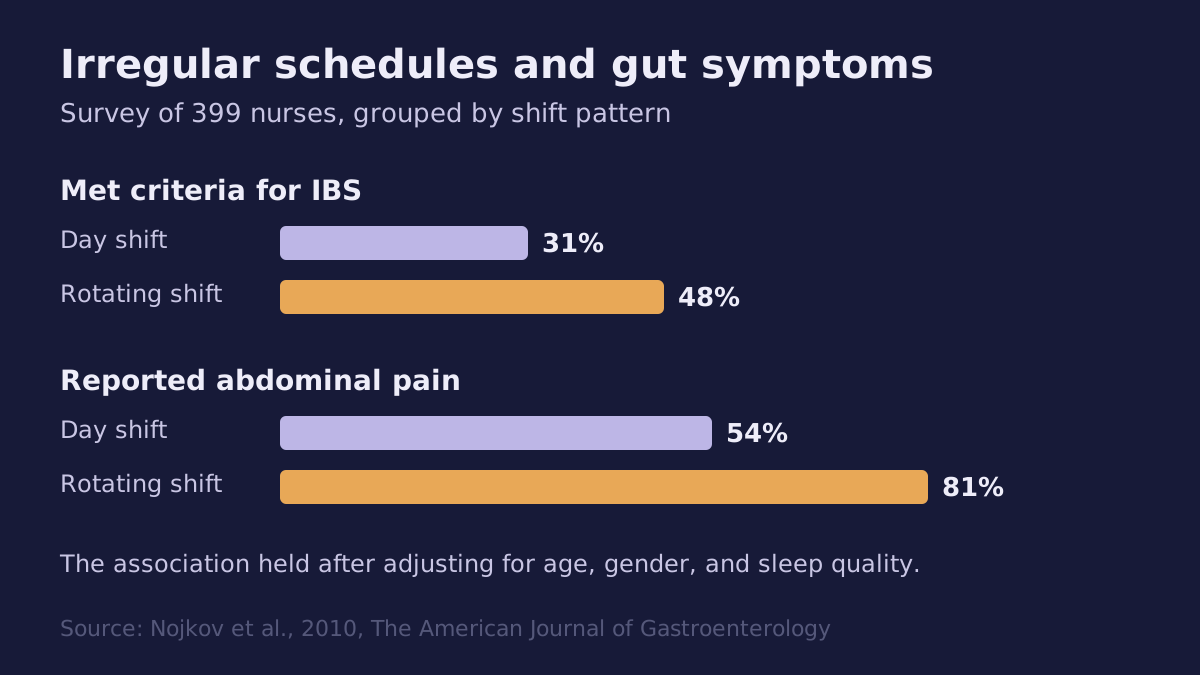
The clearest real-world illustration comes from nurses. A 2010 study in The American Journal of Gastroenterology (Nojkov et al.) surveyed 399 nurses working day, night, or rotating shifts. Among those on rotating shifts, 48% met criteria for IBS, compared with 31% of day-shift nurses. Abdominal pain was reported by 81% of rotating-shift nurses versus 54% of those on days.
Importantly, the association held even after the researchers adjusted for sleep quality. In other words, it was not only that rotating-shift nurses slept worse. The constant rescheduling of their body clocks appeared to carry its own cost for the gut.
 Source: Nojkov et al., 2010, The American Journal of Gastroenterology
The gut-brain axis: why a bad night shows up in your belly the next day
The gut and brain are in constant conversation through the vagus nerve, stress hormones, immune signaling, and chemical messengers produced by gut bacteria. That connection is why anxiety can produce stomach cramps and why digestive distress can make it hard to settle down at night.
Sleep disturbance is extremely common in people with gut disorders. A 2018 meta-analysis of 36 studies and more than 63,000 participants in the Saudi Journal of Gastroenterology (Wang et al.) estimated that about 38% of people with IBS have a sleep disorder, and that the odds of sleep problems were roughly two and a half times higher than in people without IBS.
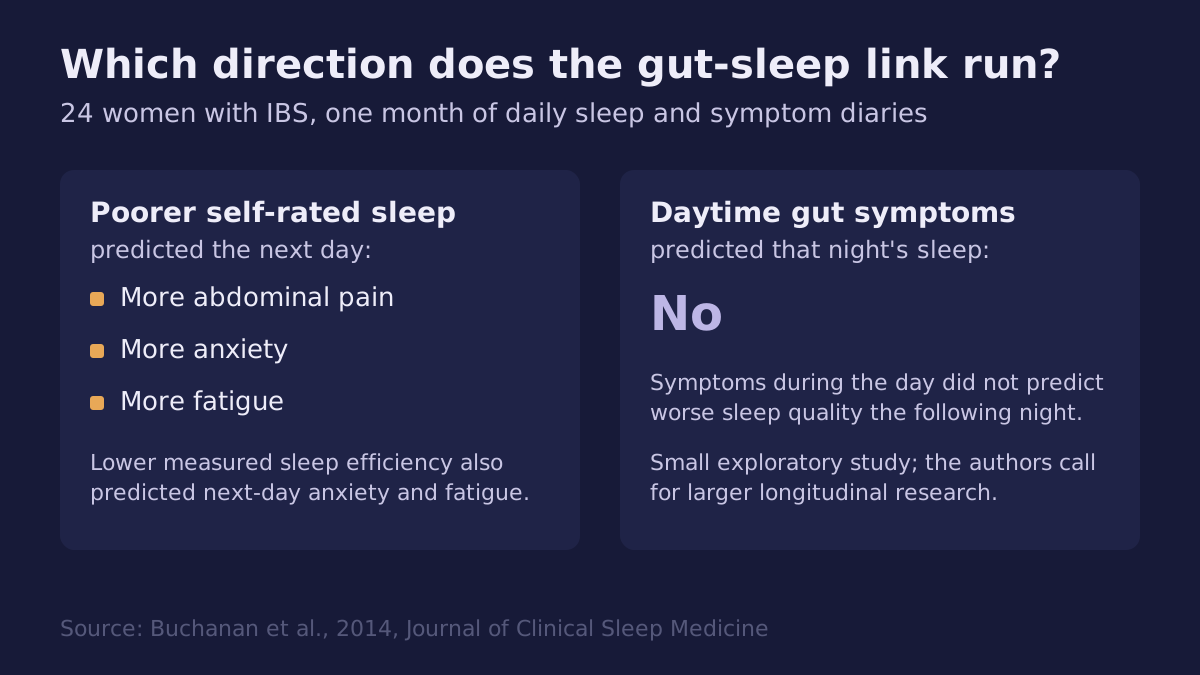
It is tempting to assume the gut symptoms are what ruin sleep. Day to day, though, the arrow seems to point mostly the other way. A 2014 study in the Journal of Clinical Sleep Medicine (Buchanan et al.) had 24 women with IBS keep daily sleep and symptom diaries for a full month while wearing a wrist monitor for one week. Poorer self-rated sleep predicted more abdominal pain, anxiety, and fatigue the following day. Lower objectively measured sleep efficiency also predicted next-day anxiety and fatigue. But daytime gut symptoms did not predict worse sleep that night.
 Source: Buchanan et al., 2014, Journal of Clinical Sleep Medicine
The practical takeaway: if your bloating and discomfort are worse after poor sleep, the sleep may be a cause, not just a casualty. Bloating is partly a sensation of pressure, and a nervous system running on little sleep tends to register that pressure more acutely.
What better sleep may do for your gut
Here is the honest state of the evidence: no clinical trial has yet shown that treating a sleep problem reduces bloating. What the research does support is that the gut responds to sleep quickly, that people who sleep more efficiently tend to have more diverse gut bacteria, and that in people with IBS, better nights are followed by better days.
The most defensible steps are the ones that address both sleep duration and sleep timing:
- Keep your sleep window steady. Going to bed and waking at roughly the same times, including on weekends, gives your body clock and your gut's daily rhythm a stable anchor. The nurse study is a reminder that constant rescheduling has a cost even when total sleep looks adequate.
- Keep meal times steady as well. The Thaiss study found that feeding rhythm was the main driver of the microbiome's daily cycle. Regular meal timing is one of the few circadian levers that is entirely under your control.
- Protect enough time in bed. Four hours, the short-sleep condition in the Benedict study, is extreme, but effects that appear after two nights at four hours are worth taking seriously over months at six.
- Treat insomnia if it is the problem. If you lie awake for long stretches or wake repeatedly, the issue is not just scheduling. The American Academy of Sleep Medicine's 2021 clinical practice guideline (Edinger et al.) gives its strongest recommendation to multicomponent cognitive behavioral therapy for insomnia (CBT-I) as the treatment for chronic insomnia in adults. Notably, the same guideline recommends against sleep hygiene education on its own as a standalone treatment, so if tidy habits have not fixed your sleep, that is expected rather than a personal failure.
When bloating needs its own evaluation
Sleep is one input to gut health, not a substitute for a proper workup. See a doctor in person about your digestion, rather than assuming sleep is the explanation, if bloating comes with blood in the stool, unintended weight loss, persistent vomiting, difficulty swallowing, a lasting change in bowel habits, or pain that wakes you from sleep. Those symptoms warrant evaluation on their own merits. If you already have a diagnosis like IBS, inflammatory bowel disease, or celiac disease, your gastroenterologist or primary care clinician should be your first call for gut symptoms, and improving your sleep can be worked on alongside that care.
If your sleep has been poor for more than a few weeks and it is affecting how you feel during the day, in your gut or anywhere else, that is a reasonable thing to raise with a clinician on its own.
Frequently asked questions
Can one night of bad sleep cause bloating?
Possibly, but the evidence is clearer for sustained patterns. The one controlled human study measured gut bacteria changes after two consecutive short nights, and the IBS diary study found that a poor night predicted more abdominal pain the next day. A single rough night is unlikely to do lasting harm; the concern is when short or irregular sleep becomes the norm.
Does lack of sleep cause gas and constipation?
No study has measured gas or stool frequency directly after sleep restriction, so the honest answer is that it has not been proven. What has been shown is that short sleep changes the balance of gut bacteria within days, and that people with irregular schedules report more abdominal pain and IBS symptoms. Both of those plausibly affect gas and bowel regularity, but the direct link remains to be tested.
How long does it take for the gut to recover after improving sleep?
Nobody knows precisely. The microbiome shifted within two nights of short sleep in the Benedict study, which suggests it can also respond quickly in the other direction, but that study did not include a recovery period. If you are changing your sleep schedule, give it several weeks of consistency before judging whether your gut symptoms have improved.
Is it the lack of sleep or the stress that causes gut problems?
Both, and they are hard to separate. Stress disrupts sleep and directly affects the gut through the same gut-brain pathways. The shift-work study is informative here because the link between rotating shifts and IBS held after adjusting for sleep quality, suggesting circadian disruption has an effect of its own. In practice, steadying your schedule tends to help on both fronts.
Sources
- Benedict C, Vogel H, Jonas W, et al. (2016). Gut microbiota and glucometabolic alterations in response to recurrent partial sleep deprivation in normal-weight young individuals. Molecular Metabolism, 5(12), 1175–1186. https://doi.org/10.1016/j.molmet.2016.10.003
- Smith RP, Easson C, Lyle SM, et al. (2019). Gut microbiome diversity is associated with sleep physiology in humans. PLoS One, 14(10), e0222394. https://doi.org/10.1371/journal.pone.0222394
- Thaiss CA, Zeevi D, Levy M, et al. (2014). Transkingdom control of microbiota diurnal oscillations promotes metabolic homeostasis. Cell, 159(3), 514–529. https://doi.org/10.1016/j.cell.2014.09.048
- Nojkov B, Rubenstein JH, Chey WD, Hoogerwerf WA. (2010). The impact of rotating shift work on the prevalence of irritable bowel syndrome in nurses. The American Journal of Gastroenterology, 105(4), 842–847. https://doi.org/10.1038/ajg.2010.48
- Wang B, Duan R, Duan L. (2018). Prevalence of sleep disorder in irritable bowel syndrome: A systematic review with meta-analysis. Saudi Journal of Gastroenterology, 24(3), 141–150. https://doi.org/10.4103/sjg.SJG_603_17
- Buchanan DT, Cain K, Heitkemper M, et al. (2014). Sleep measures predict next-day symptoms in women with irritable bowel syndrome. Journal of Clinical Sleep Medicine, 10(9), 1003–1009. https://doi.org/10.5664/jcsm.4038
- Edinger JD, Arnedt JT, Bertisch SM, et al. (2021). Behavioral and psychological treatments for chronic insomnia disorder in adults: an American Academy of Sleep Medicine clinical practice guideline. Journal of Clinical Sleep Medicine, 17(2), 255–262. https://doi.org/10.5664/jcsm.8986
This article is for general education and is not medical advice. Talk with a licensed clinician about your own symptoms before starting, stopping, or changing any treatment.