November 1, 2026
Why You're Scared to Go to Bed (and How the Fear Fades)
By the My Circadian Health editorial team. Reviewed by Brandon Korenek, Founder.
Why bedtime starts to feel frightening
If you are scared to go to bed because you won't be able to sleep, you are describing something sleep researchers have studied for decades. After a run of bad nights, the bed stops being a place where sleep happens and becomes a place where you lie awake and worry. Your brain learns that link, and by evening the dread arrives on schedule, often before you are even tired.
The short answer to "what do I do about it" is this: the fear usually eases when you stop trying to force sleep, keep the bed for sleep only, and give your body a steady schedule to anchor to. When the pattern has lasted for months, a structured program called cognitive behavioral therapy for insomnia (CBT-I) is the treatment the American Academy of Sleep Medicine most strongly recommends. The rest of this article explains why the dread builds and how each of those steps works against it.
The worry loop that keeps you awake
The most cited explanation comes from a 2002 paper in Behaviour Research and Therapy (Harvey). It describes insomnia as a loop driven by worry, built on the same principles as models of anxiety disorders:
- Worry. You worry about not sleeping and about how tomorrow will go if you don't.
- Arousal. That worry switches on physical arousal and emotional distress, which are the opposite of the calm state sleep needs.
- Monitoring. The anxious state makes you scan for threats: checking the clock, noticing your heartbeat, counting how many hours are left.
- Distorted perception. Anxiety and monitoring together lead you to overestimate how little you slept and how badly you are functioning, which feeds more worry.
Harvey also points to "safety behaviors" that seem helpful but keep the loop going, such as trying to suppress thoughts or control your mental images. The paper's bleakest point is also the most useful one: the escalating anxiety can eventually cause a real sleep deficit, even if it started as a perceived one. Bedtime dread is not a weakness. It is the loop doing what it does.
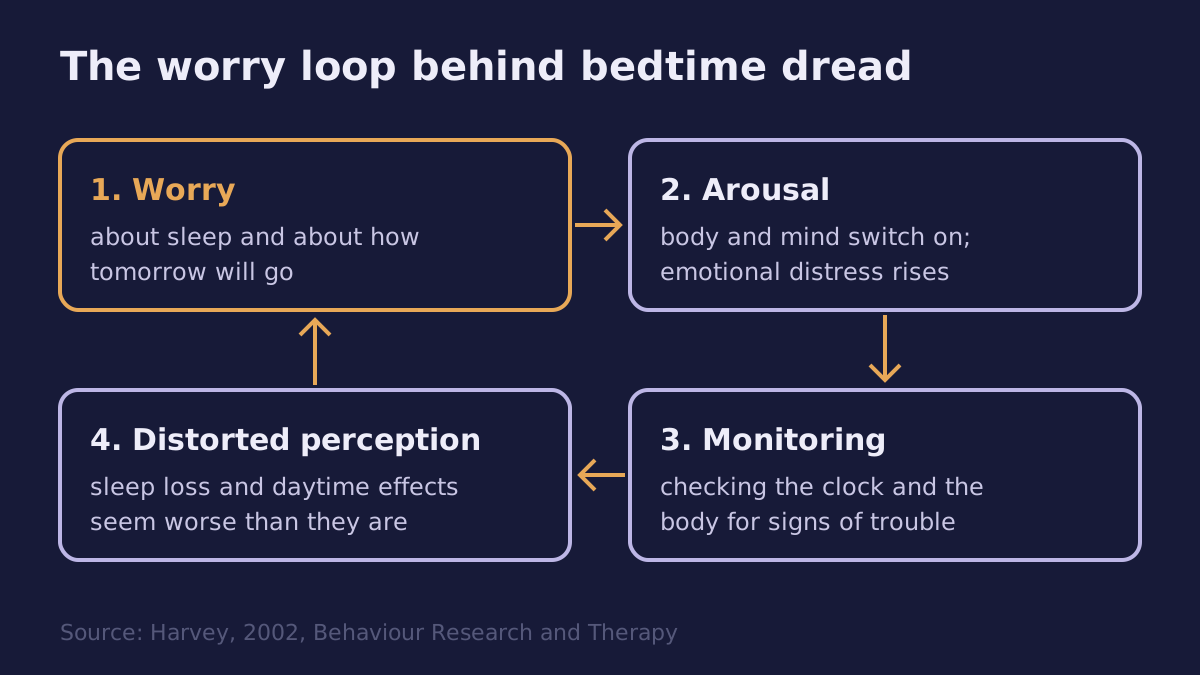 Source: Harvey, 2002, Behaviour Research and Therapy
Why trying harder to sleep makes it worse
Sleep is involuntary. You cannot will yourself into it any more than you can will yourself to blush. Researchers at the University of Glasgow built a questionnaire, the Glasgow Sleep Effort Scale, specifically because they kept seeing patients with insomnia strive to control their sleep. As they put it in the Journal of Sleep Research, direct, voluntary attempts to control sleep may actually exacerbate and perpetuate insomnia (Broomfield and Espie, 2005).
A related theoretical review, the "attention-intention-effort pathway," argues that good sleep is a fairly automatic process, and that this makes it vulnerable to being disrupted by focused attention and direct attempts to control it (Espie et al., 2006). In plain terms: the more carefully you prepare, monitor, and push for sleep, the more alert you become.
That explains a pattern many people recognize. You feel drowsy on the couch, walk to the bedroom, and the moment your head hits the pillow you are wide awake. The couch carries no pressure. The bed carries all of it.
What helps when you dread going to bed
None of the steps below promise a good night tonight. They are aimed at breaking the link between your bed and wakeful worry, which takes repetition over weeks.
Go to bed only when you are sleepy
Sleepy means heavy eyelids and nodding off, not just tired or worn out. Going to bed early "to give yourself a head start" usually means more time lying awake, which strengthens the very association you are trying to break. This is one of the five stimulus control instructions described in the 2021 AASM guideline on behavioral treatments for insomnia (Edinger et al., 2021).
Get up when you can't sleep
If you are lying awake and frustrated, get out of bed, go to another dim room, and do something quiet until you feel sleepy again. Then return. The goal is to stop rehearsing wakefulness in bed. The same guideline lists using the bed only for sleep and sex, waking at the same time every morning, and avoiding daytime naps as the other stimulus control instructions. It suggests stimulus control on its own as a conditional recommendation for chronic insomnia.
Stop watching the clock
Clock-checking is a textbook example of the threat monitoring Harvey describes. Every glance starts a calculation ("if I fall asleep now I'll get four hours"), and every calculation raises arousal. Turn the clock away or put your phone out of reach. Your alarm will still go off.
Try giving up on sleep, on purpose
This sounds backwards, but it has research behind it. Paradoxical intention asks you to drop the goal of falling asleep and instead let yourself stay awake in bed, quietly, without fighting it. In a small randomized trial of 34 people who had trouble falling asleep, those who practiced it for 14 nights reported significantly less sleep effort and less sleep performance anxiety than a control group (Broomfield and Espie, 2003). Their sleep onset, measured with a wrist activity monitor, did not differ from controls, so think of this as a way to take the pressure off rather than a sleep switch.
Keep the wake-up time fixed
After a bad night, sleeping in feels like recovery. It also weakens the sleep drive you will need the next night. A consistent wake time, even on weekends, is one of the stimulus control instructions in the AASM guideline and gives your body a reliable anchor.
When bedtime dread is a sign of chronic insomnia
An occasional anxious night before a big event is normal. Dread that shows up most nights, lasts for weeks or months, and affects how you function during the day may point to chronic insomnia, and it is worth talking with a clinician about.
The strongest recommendation in the 2021 AASM guideline is for multicomponent CBT-I, which combines stimulus control, sleep restriction (temporarily limiting time in bed to consolidate sleep), and cognitive work on unhelpful beliefs about sleep (Edinger et al., 2021). A 2015 meta-analysis in Annals of Internal Medicine pooled 20 trials with 1,162 adults and found that, after treatment, CBT-I shortened the time to fall asleep by about 19 minutes and cut time awake after first falling asleep by about 26 minutes on average (Trauer et al., 2015). The authors noted the gains appeared to last, though later estimates were less certain.
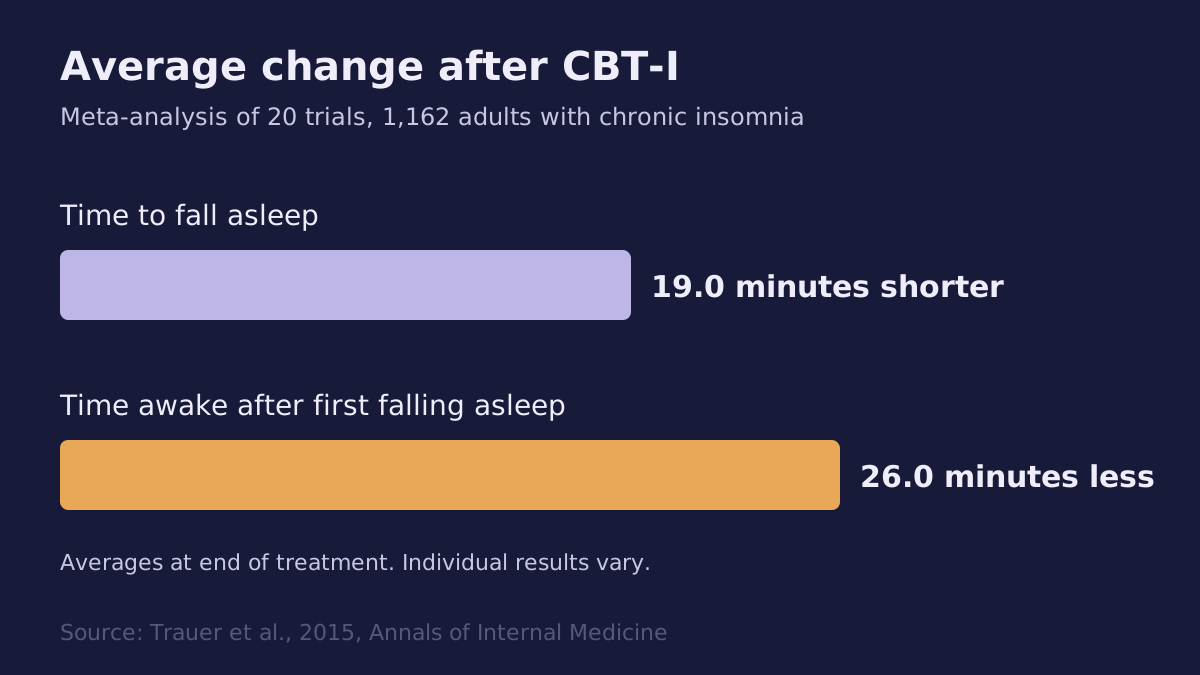 Source: Trauer et al., 2015, Annals of Internal Medicine
Some people with persistent insomnia also wonder about sleep medication. Medication has its own benefits and risks, and whether it is appropriate for you is a decision for a licensed clinician to make after evaluating your sleep, health history, and other medications.
When to get in-person care
Some patterns call for an in-person evaluation rather than self-help:
- Loud snoring, gasping, or pauses in breathing that a partner notices, or heavy daytime sleepiness, which can point to sleep apnea.
- Anxiety or low mood that fills the whole day, not just bedtime.
- Panic attacks at night, or relying on alcohol or other substances to get to sleep.
If you are having thoughts of harming yourself, call or text 988 to reach the 988 Suicide and Crisis Lifeline, available 24 hours a day in the United States.
Frequently asked questions
Is it normal to be scared to go to bed?
It is common among people with insomnia. Research on the cognitive model of insomnia describes how worry about sleep triggers arousal and threat monitoring, which can make the bed itself feel like a source of anxiety. That pattern is well recognized and is one of the things CBT-I is designed to address.
What is it called when you are afraid of going to sleep?
Fear of sleep is sometimes called somniphobia, though that is an informal term rather than a formal diagnosis. When the fear centers on not being able to sleep, clinicians often describe it as sleep-related performance anxiety or conditioned arousal, which are features of chronic insomnia. A clinician can help sort out whether something else, such as nightmares or a panic disorder, is involved.
How long does it take to stop dreading bedtime?
There is no fixed timeline, and it varies from person to person. Behavioral approaches like stimulus control work through repetition, so most programs ask people to follow them consistently for several weeks. If the dread has not eased after a sustained effort, talk with a clinician about structured CBT-I.
Should I stay in bed and rest if I can't sleep?
The stimulus control approach recommended in the AASM guideline suggests getting up when you cannot sleep and returning when you feel sleepy. Lying awake in bed for long stretches can strengthen the link between the bed and wakefulness. Paradoxical intention is a different technique, in which you stay in bed but stop trying to sleep, so a clinician can help you pick the approach that fits.
Sources
- Harvey AG. (2002). A cognitive model of insomnia. Behaviour Research and Therapy, 40(8), 869-893. https://doi.org/10.1016/s0005-7967(01)00061-4
- Broomfield NM, Espie CA. (2005). Towards a valid, reliable measure of sleep effort. Journal of Sleep Research, 14(4), 401-407. https://doi.org/10.1111/j.1365-2869.2005.00481.x
- Espie CA, Broomfield NM, MacMahon KM, Macphee LM, Taylor LM. (2006). The attention-intention-effort pathway in the development of psychophysiologic insomnia: a theoretical review. Sleep Medicine Reviews. https://doi.org/10.1016/j.smrv.2006.03.002
- Broomfield NM, Espie CA. (2003). Initial insomnia and paradoxical intention: an experimental investigation of putative mechanisms using subjective and actigraphic measurement of sleep. Behavioural and Cognitive Psychotherapy, 31(3), 313-324. https://doi.org/10.1017/S1352465803003060
- Edinger JD, Arnedt JT, Bertisch SM, et al. (2021). Behavioral and psychological treatments for chronic insomnia disorder in adults: an American Academy of Sleep Medicine clinical practice guideline. Journal of Clinical Sleep Medicine, 17(2), 255-262. https://doi.org/10.5664/jcsm.8986
- Trauer JM, Qian MY, Doyle JS, Rajaratnam SMW, Cunnington D. (2015). Cognitive behavioral therapy for chronic insomnia: a systematic review and meta-analysis. Annals of Internal Medicine, 163(3), 191-204. https://doi.org/10.7326/M14-2841
This article is for general education and is not medical advice. Talk with a licensed clinician about your own symptoms before starting, stopping, or changing any treatment.