November 6, 2026
Do You Need a Sleep Study for Insomnia?
By the My Circadian Health editorial team. Reviewed by Brandon Korenek, Founder.
The short answer
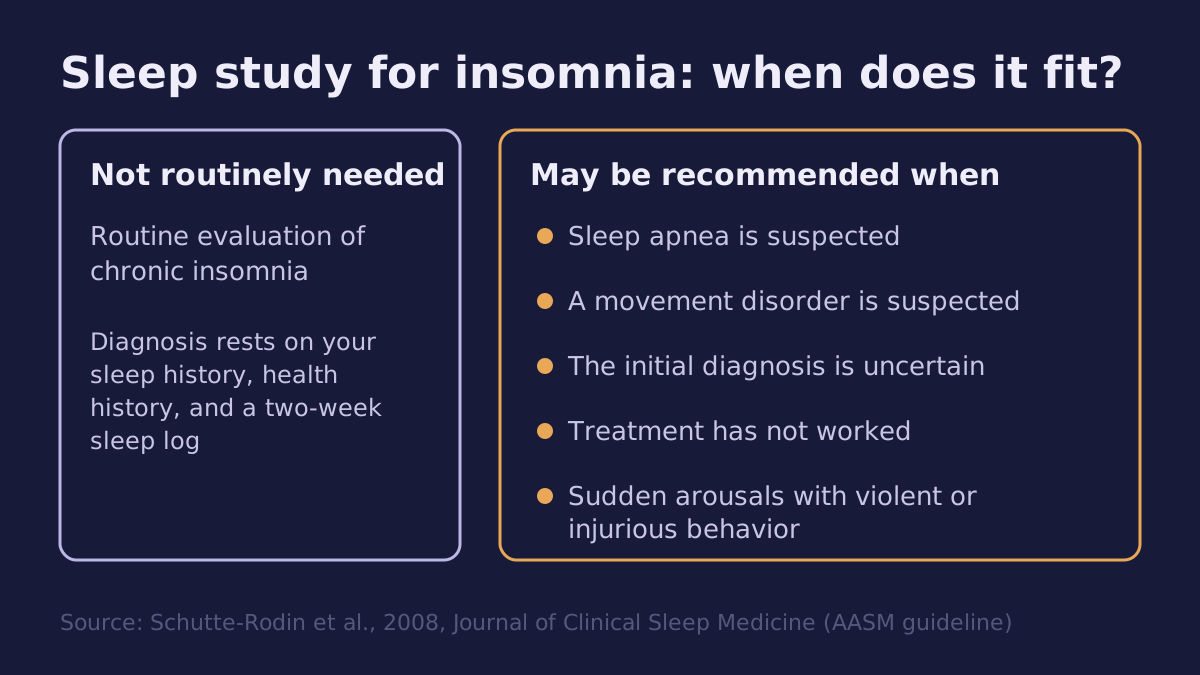
For most adults, you do not need a sleep study for insomnia. Insomnia is diagnosed from your history: how long it takes you to fall asleep, how often you wake, how long the problem has lasted, and how it affects your days. The American Academy of Sleep Medicine (AASM) guideline on chronic insomnia states that an overnight sleep study (polysomnography) is "not indicated in the routine evaluation of chronic insomnia" (Schutte-Rodin et al., 2008).
A study does become the right call in specific situations. The same guideline lists them: when there is a reasonable suspicion of sleep apnea or a movement disorder, when the diagnosis is uncertain, when treatment has not worked, or when you have sudden arousals with violent or injurious behavior. If none of those fit you, the more useful first steps are usually a two-week sleep diary and a conversation with a clinician about insomnia-specific treatment.
Why a sleep study usually isn't the first step
A sleep study is built to catch things that happen while you are asleep and cannot report on yourself: pauses in breathing, drops in blood oxygen, leg movements, unusual behavior in dream sleep. It records brain waves, breathing, heart rhythm, and muscle activity for one night, usually in a lab.
Insomnia is different. The core problem is trouble falling asleep, staying asleep, or waking too early, plus daytime consequences. You already know those things are happening. That is why the AASM guideline says insomnia "is primarily diagnosed by clinical evaluation," built on a thorough sleep history and a detailed medical, substance, and psychiatric history, with a sleep log as a recommended part of the workup (Schutte-Rodin et al., 2008).
This explains the forum posts from people with insomnia whose lab study came back "normal" and changed nothing. One night in an unfamiliar room with wires attached can show that you slept poorly, but it cannot explain months of poor sleep when no breathing or movement problem is present.
 Source: Schutte-Rodin et al., 2008, Journal of Clinical Sleep Medicine
When you may need a sleep study for insomnia
Think of a sleep study as a tool for ruling something in or out. These are the situations where the AASM guideline supports testing.
Signs that point to sleep apnea
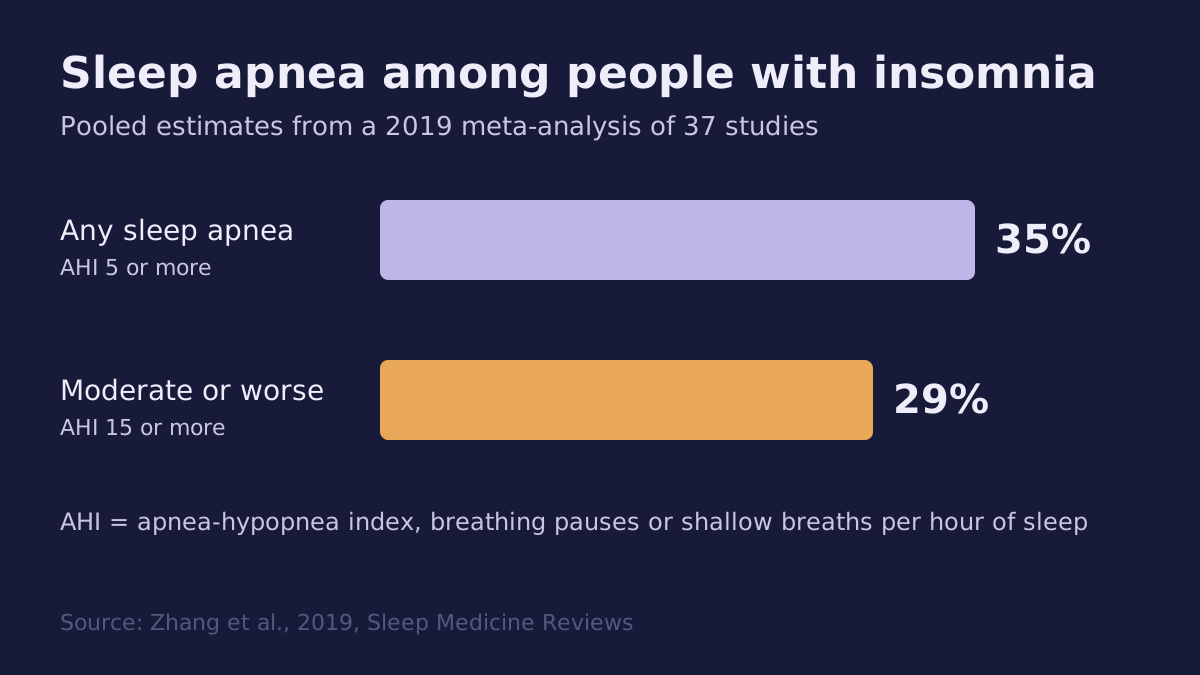
Sleep apnea and insomnia overlap more than many people realize. A 2019 meta-analysis in Sleep Medicine Reviews pooled 37 studies and found that among people being seen for insomnia, about 29% had at least moderate obstructive sleep apnea (an apnea-hypopnea index of 15 or more) (Zhang et al., 2019). That does not mean you have apnea, but the overlap is common enough to take seriously.
Insomnia can even be one of the symptoms of sleep apnea. The AASM guideline on apnea testing lists "fatigue or insomnia" next to loud snoring and witnessed pauses in breathing as typical symptoms (Kapur et al., 2017). The same guideline describes an increased risk of moderate to severe apnea as excessive daytime sleepiness plus at least two of these three:
- Habitual loud snoring
- Someone seeing you stop breathing, or you waking up gasping or choking
- A diagnosis of high blood pressure
 Source: Zhang et al., 2019, Sleep Medicine Reviews
A questionnaire or a smartwatch cannot settle this. The AASM recommends that questionnaires and prediction tools "not be used to diagnose OSA in adults" without a sleep study or home sleep apnea test (Kapur et al., 2017). If these signs sound familiar, an in-person evaluation with your primary care doctor or a sleep medicine clinic is the right path.
Leg sensations or movements at night
An urge to move your legs at bedtime, or a bed partner who notices your legs jerking through the night, can point to a movement disorder. The AASM insomnia guideline lists suspected movement disorders as a reason for polysomnography (Schutte-Rodin et al., 2008).
The diagnosis is unclear
Sometimes the picture does not add up, or your symptoms fit more than one condition. An uncertain initial diagnosis is one of the reasons the guideline gives for a sleep study.
Treatment hasn't helped
If you have given insomnia treatment a real try, whether behavioral or medical, and you are not improving, the guideline supports a sleep study to look for a missed disorder (Schutte-Rodin et al., 2008). This is one of the most common reasons a study is worth doing for someone with long-standing insomnia.
Violent or injurious behavior during sleep
The guideline also lists sudden arousals with violent or injurious behavior, such as striking out at a bed partner or hurting yourself during the night. This calls for a study and an in-person evaluation.
Home test or lab study?
If a clinician suspects sleep apnea, you may be offered a home sleep apnea test, a smaller device you wear for a night in your own bed. The AASM supports home testing for uncomplicated adults with signs of moderate to severe apnea (Kapur et al., 2017).
There is a catch that matters if you have insomnia. The same guideline recommends an in-lab study rather than a home test for people with severe insomnia, along with some other conditions, because severe insomnia can interfere with the accuracy of home testing. A home test also needs a minimum of four hours of usable data. If you barely sleep on a bad night, a home test can come back inconclusive, and the guideline recommends a lab study when a single home test is negative, inconclusive, or technically inadequate.
So if you are scheduled for a home test, tell the clinician how much you are actually sleeping. It may change which test makes sense.
What a clinician uses instead
When a sleep study isn't needed, evaluation of insomnia leans on a few simpler tools.
A two-week sleep diary
The AASM insomnia guideline recommends a two-week sleep log to capture bedtimes, wake times, patterns, and night-to-night variation, ideally before your first visit (Schutte-Rodin et al., 2008). Each morning, write down roughly when you went to bed, how long it took to fall asleep, how many times you woke and for how long, when you got up, and anything relevant such as caffeine, alcohol, naps, or a stressful day. Estimates are fine. You are looking for a pattern, not a perfect record.
A diary can show things a single night in a lab cannot, like a schedule that drifts later on weekends or long stretches awake in bed.
Actigraphy, sometimes
Actigraphy uses a small motion-sensing device, typically worn on the wrist or ankle, to estimate sleep and wake over days or weeks. A 2018 AASM guideline suggests clinicians may use actigraphy to estimate sleep in adults with insomnia disorder, rated as a conditional recommendation (Smith et al., 2018). Its recommendations apply only to FDA-approved devices; consumer wearables were outside its scope.
What to do next if you don't need a study
If your history does not point to sleep apnea or another condition that needs testing, the evidence-based next step is treatment aimed at the insomnia itself.
The AASM's 2021 guideline gives a strong recommendation for multicomponent cognitive behavioral therapy for insomnia (CBT-I) for adults with chronic insomnia disorder (Edinger et al., 2021). As the guideline describes it, CBT-I combines cognitive strategies and education about sleep regulation with stimulus control instructions (in plain terms, using the bed only for sleep) and sleep restriction therapy (temporarily matching time in bed to the sleep you are actually getting). The guideline notes that CBT-I typically runs four to eight visits, and that briefer versions of one to four sessions also earned a conditional recommendation. It advises against relying on sleep hygiene tips alone.
Medication is a separate question. Whether any medicine has a place in your care, and which kind, is a decision for a licensed clinician after an evaluation of your symptoms, health history, and risks. It is not the automatic outcome of seeing someone about insomnia.
The plan can also change. If you work through treatment and still are not sleeping better, that is exactly the point at which a sleep study is worth revisiting.
Frequently asked questions
Can a sleep study diagnose insomnia?
A sleep study can show that you slept poorly on the night it was recorded, but insomnia is diagnosed mainly from your history and sleep diary. The AASM does not recommend polysomnography for the routine evaluation of chronic insomnia. Its main value is ruling out other disorders, such as sleep apnea, that can cause or worsen insomnia.
Why was my sleep study normal when I can't sleep?
A sleep study looks for breathing problems, movement disorders, and other events during sleep. If you have insomnia without those conditions, a "normal" result is expected and does not mean your sleep trouble is imaginary. It usually means insomnia-specific treatment is the next step.
Can insomnia be a sign of sleep apnea?
Yes. The AASM lists insomnia among the typical symptoms of obstructive sleep apnea, and a 2019 meta-analysis found that about 29% of people evaluated for insomnia had at least moderate apnea. Loud snoring, gasping at night, witnessed breathing pauses, or heavy daytime sleepiness are reasons to ask a clinician about testing.
Is a home sleep test enough if I have insomnia?
It depends. Home tests are designed mainly to detect sleep apnea, and the AASM recommends an in-lab study instead for people with severe insomnia. A home test also needs at least four hours of usable data, which can be hard to get on a bad night.
How long should I keep a sleep diary before seeing someone?
The AASM insomnia guideline suggests about two weeks. That is usually long enough to show your typical pattern and any day-to-day variation, and it gives a clinician much more to work with than a description from memory.
Sources
- Schutte-Rodin S, Broch L, Buysse D, Dorsey C, Sateia M. (2008). Clinical guideline for the evaluation and management of chronic insomnia in adults. Journal of Clinical Sleep Medicine, 4(5), 487–504. https://pmc.ncbi.nlm.nih.gov/articles/PMC2576317/
- Kapur VK, Auckley DH, Chowdhuri S, et al. (2017). Clinical practice guideline for diagnostic testing for adult obstructive sleep apnea: an American Academy of Sleep Medicine clinical practice guideline. Journal of Clinical Sleep Medicine, 13(3), 479–504. https://doi.org/10.5664/jcsm.6506
- Zhang Y, Ren R, Lei F, et al. (2019). Worldwide and regional prevalence rates of co-occurrence of insomnia and insomnia symptoms with obstructive sleep apnea: a systematic review and meta-analysis. Sleep Medicine Reviews, 45, 1–17. https://doi.org/10.1016/j.smrv.2019.01.004
- Smith MT, McCrae CS, Cheung J, et al. (2018). Use of actigraphy for the evaluation of sleep disorders and circadian rhythm sleep-wake disorders: an American Academy of Sleep Medicine clinical practice guideline. Journal of Clinical Sleep Medicine, 14(7), 1231–1237. https://doi.org/10.5664/jcsm.7230
- Edinger JD, Arnedt JT, Bertisch SM, et al. (2021). Behavioral and psychological treatments for chronic insomnia disorder in adults: an American Academy of Sleep Medicine clinical practice guideline. Journal of Clinical Sleep Medicine, 17(2), 255–262. https://doi.org/10.5664/jcsm.8986
This article is for general education and is not medical advice. Talk with a licensed clinician about your own symptoms before starting, stopping, or changing any treatment.