November 4, 2026
Sleep Tracker Says You Slept Fine but You're Exhausted?
By the My Circadian Health editorial team. Reviewed by Brandon Korenek, Founder.
Why your sleep tracker says you slept fine but you're exhausted
If your sleep tracker says you slept fine but you're exhausted, believe how you feel before you believe the number. Consumer trackers are good at spotting sleep and much weaker at spotting quiet wakefulness. They can count time you spent lying still and awake as sleep, which makes a broken night look like a solid one.
The mismatch usually comes down to one of three things: the tracker overcounted your sleep, you are sleeping but the sleep is not restoring you, or the problem is not about your sleep at all. Each one points to a different next step, and a few signs mean it is worth talking to a clinician instead of waiting for a better score.
What your tracker is actually measuring
Most wrist trackers do not measure sleep directly. A lab sleep study (polysomnography) records brain waves, breathing, and muscle activity. A watch or ring mostly reads movement and heart rate, then uses a private algorithm to guess whether you were asleep.
That guess has a known blind spot. A 2019 review in Medicine and Science in Sports and Exercise (de Zambotti et al.) found that wearables show high sensitivity (above 90%) for detecting sleep but lower specificity for detecting wake. In plain terms, they rarely miss sleep, but they often miss wakefulness. The result is a total sleep time that runs high and a wake time that runs low.
How big the gap can be
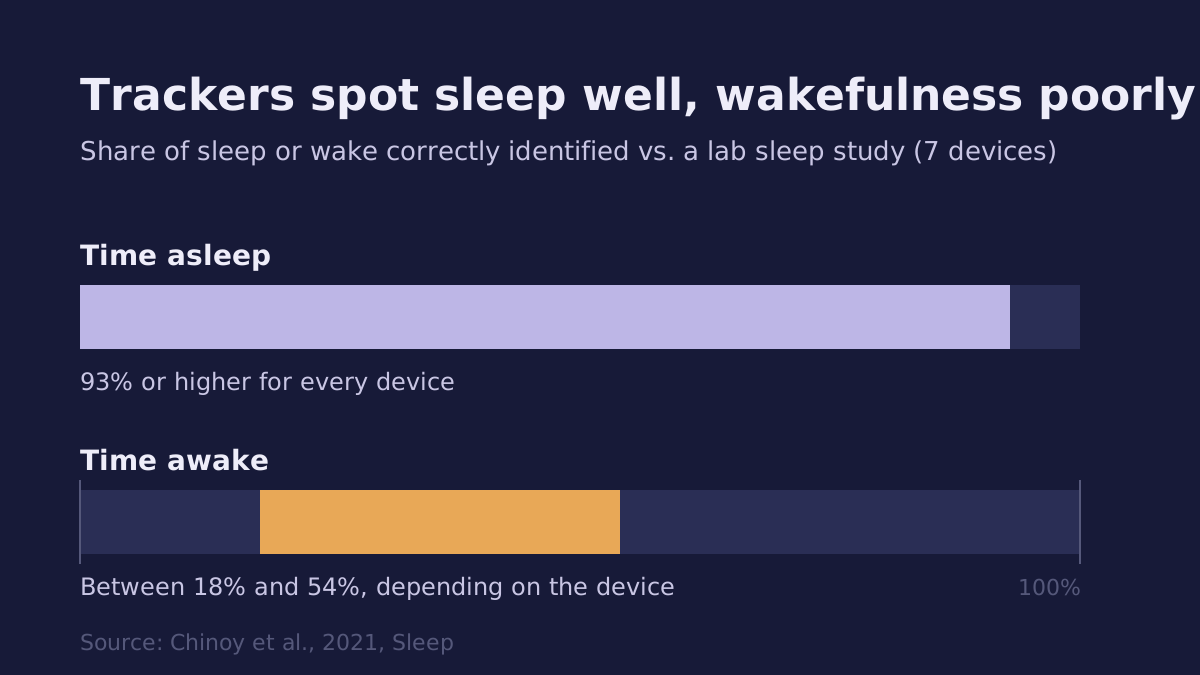
A 2021 study in Sleep (Chinoy et al.) tested seven consumer sleep trackers against polysomnography in 34 healthy young adults. Every device correctly identified at least 93% of the time people were asleep. But for time spent awake, the devices were right only 18% to 54% of the time, depending on the device. Several of the devices also significantly overestimated total sleep time.
 Source: Chinoy et al., 2021, Sleep
Two details from that research matter if you feel tired:
- The worse the night, the worse the estimate. Chinoy and colleagues found the devices tended to perform worse on nights with poorer or disrupted sleep. The de Zambotti review reached the same conclusion: more wake breaking up the night made the device errors larger.
- Sleep stages are the shakiest number. Chinoy et al. described device sleep stage results as inconsistent, and de Zambotti et al. found deep sleep and wake were the least reliable categories. A low or high "deep sleep" figure on one night is not something to read much into.
So the nights when you feel worst may be exactly the nights your tracker is least accurate. If you lay awake for long stretches without tossing around, the device may have logged that time as sleep.
Three reasons you can feel exhausted after a "good" night
1. The tracker overcounted your sleep
This is the simplest explanation, and the research above suggests it is common. If you remember waking several times, lying awake at 4 a.m., or drifting in and out before the alarm, trust that memory. Your real sleep may have been shorter than the app says.
It also helps to check the baseline. A joint consensus statement from the American Academy of Sleep Medicine and Sleep Research Society (Watson et al., 2015) recommends that adults sleep 7 or more hours per night on a regular basis. The same statement notes that more than 9 hours may be appropriate for young adults, people recovering from sleep debt, and people who are ill. A tracker that reports 6 hours 40 minutes and calls it "good" is still describing less than the recommended amount, and the true number may be lower.
2. You slept, but the sleep was not restorative
Some sleep problems interrupt sleep without fully waking you. Obstructive sleep apnea is the best-known example. Breathing repeatedly narrows or stops, and the brain briefly rouses to restart it. You may not remember any of it, and a movement-based tracker is not built to detect it.
According to the National Heart, Lung, and Blood Institute, signs of sleep apnea include loud snoring, breathing that starts and stops, gasping for air, daytime sleepiness and tiredness, headaches, and waking often to urinate. NHLBI notes that a sleep study may be needed to diagnose it.
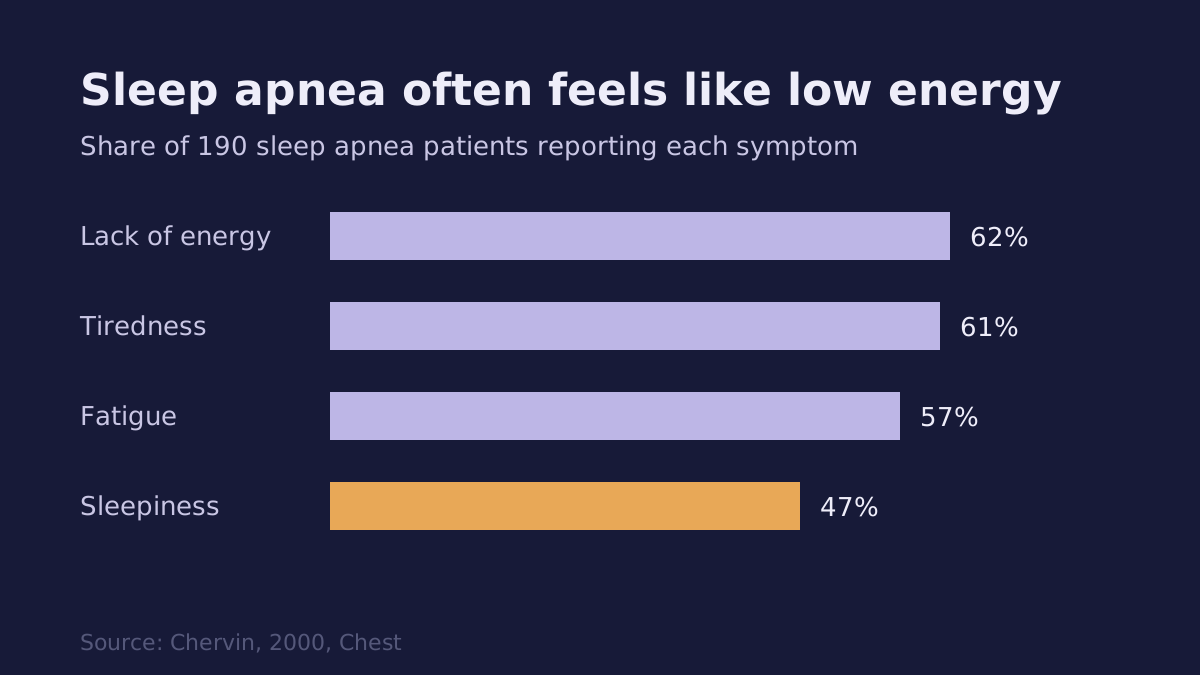
People with sleep apnea do not always describe themselves as "sleepy." In a study of 190 patients with obstructive sleep apnea published in Chest (Chervin, 2000), 62% reported lack of energy, 61% tiredness, and 57% fatigue, compared with 47% who reported sleepiness. The author concluded that complaints of fatigue, tiredness, or lack of energy may matter as much as sleepiness, and that the diagnosis should not be ruled out just because someone emphasizes those words.
 Source: Chervin, 2000, Chest
That is why "I sleep fine, I'm just exhausted" deserves a real evaluation, especially if a bed partner has noticed snoring or pauses in your breathing. Suspected sleep apnea calls for an in-person evaluation and a sleep test, not a better sleep score.
3. The tiredness is not coming from your sleep
Persistent exhaustion has many possible causes, and not all of them start in the bedroom. A tracker cannot tell you whether something other than sleep is draining your energy. That is a question for a clinician who can take a history and decide whether any tests make sense. If low energy comes with low mood, loss of interest in things you used to enjoy, or thoughts of not wanting to be here, please reach out to a clinician in person, and if you are in crisis, call or text the 988 Suicide and Crisis Lifeline.
When the score itself becomes the problem
Trackers can also change how you sleep. In a 2017 case series in the Journal of Clinical Sleep Medicine, Baron et al. described patients who sought treatment for sleep problems they had identified from tracker data, and who often found the tracker data more consistent with their experience than validated sleep tests. The authors called this pattern "orthosomnia," a perfectionistic quest for ideal sleep. The patients they described spent excessive time in bed trying to raise the sleep duration their tracker reported, which the authors wrote may have made their insomnia worse. Orthosomnia is a descriptive term, not a formal diagnosis.
If you notice that checking your score each morning makes you anxious, or that a "bad" number sets the tone for your whole day, that reaction is worth mentioning to a clinician too.
How to use your tracker data without being misled
The American Academy of Sleep Medicine's position statement on consumer sleep technology (Khosla et al., 2018) says these devices cannot be used to diagnose or treat sleep disorders at this time. It also says they may help the conversation between patient and clinician when presented as part of an appropriate clinical evaluation. A practical way to apply that:
- Look at patterns, not single nights. One night's stage breakdown is the least reliable part of the report. Your bedtimes and wake times across a few weeks give a clinician more to work with.
- Write down how you feel. A quick morning note (rested, groggy, exhausted) gives a clinician information the tracker cannot.
- Note what the device cannot see. Snoring, gasping, morning headaches, or a partner's observations matter more than a sleep score.
- Bring the data, but do not let it overrule you. If the app says "great night" and you feel awful most days, the feeling is the symptom worth reporting.
When to talk to a doctor
Consider an evaluation if:
- You feel exhausted most days for several weeks, whatever your tracker says.
- You or a partner notice loud snoring, gasping, or pauses in breathing.
- You regularly get less than 7 hours of actual sleep, or lie awake for long stretches.
- Tiredness is affecting your work, driving, mood, or relationships.
- You find yourself anxious about your sleep numbers.
If snoring, gasping, or breathing pauses are part of the picture, start with your primary care doctor or a sleep clinic, since sleep apnea is diagnosed with a sleep study. For trouble falling or staying asleep, a physician can help you sort out what is going on and what options fit your situation.
Frequently asked questions
Can a sleep tracker be wrong about how much I slept?
Yes. Research comparing consumer trackers with lab sleep studies shows they detect sleep well but often miss time spent awake, so total sleep time tends to read high. The errors tend to be larger on nights with more disrupted sleep.
Why do I wake up tired even when my sleep score is high?
A high score may reflect overcounted sleep, especially if you lay awake quietly. It can also happen when sleep is broken up by something a tracker cannot detect, such as sleep apnea. Persistent tiredness can also have causes unrelated to sleep, which a clinician can help sort out.
Can a smartwatch or ring detect sleep apnea?
The American Academy of Sleep Medicine says consumer sleep technology cannot be used to diagnose sleep disorders at this time. If you have signs such as loud snoring, gasping, or pauses in breathing, talk to a clinician about a sleep study.
Is the deep sleep number on my tracker accurate?
Not very. Studies have found device sleep stage results to be inconsistent, with deep sleep and wake among the least reliable categories. Treat the stage breakdown as a rough estimate and pay more attention to how you feel during the day.
Should I stop wearing my sleep tracker?
Not necessarily. The American Academy of Sleep Medicine notes that tracker data may help the conversation with a clinician when it is reviewed as part of a proper evaluation. If checking your score makes you anxious about sleep, mention that to a clinician, who can help you decide how to use the device.
Sources
- Baron KG, Abbott S, Jao N, Manalo N, Mullen R. (2017). Orthosomnia: Are some patients taking the quantified self too far? Journal of Clinical Sleep Medicine. https://doi.org/10.5664/jcsm.6472
- Chervin RD. (2000). Sleepiness, fatigue, tiredness, and lack of energy in obstructive sleep apnea. Chest. https://doi.org/10.1378/chest.118.2.372
- Chinoy ED, Cuellar JA, Huwa KE, et al. (2021). Performance of seven consumer sleep-tracking devices compared with polysomnography. Sleep. https://doi.org/10.1093/sleep/zsaa291
- de Zambotti M, Cellini N, Goldstone A, Colrain IM, Baker FC. (2019). Wearable sleep technology in clinical and research settings. Medicine and Science in Sports and Exercise. https://doi.org/10.1249/MSS.0000000000001947
- Khosla S, Deak MC, Gault D, et al. (2018). Consumer sleep technology: An American Academy of Sleep Medicine position statement. Journal of Clinical Sleep Medicine. https://doi.org/10.5664/jcsm.7128
- National Heart, Lung, and Blood Institute. Sleep apnea: Symptoms. https://www.nhlbi.nih.gov/health/sleep-apnea/symptoms
- Watson NF, Badr MS, Belenky G, et al. (2015). Recommended amount of sleep for a healthy adult: A joint consensus statement of the American Academy of Sleep Medicine and Sleep Research Society. Journal of Clinical Sleep Medicine. https://doi.org/10.5664/jcsm.4758
This article is for general education and is not medical advice. Talk with a licensed clinician about your own symptoms before starting, stopping, or changing any treatment.